


DESCRIPTION
DE PETIT
Bergen op Zoom
Holland
Nederland
Oorsprong: Lotharingen (Frankrijk)
✶ Wapenschild / Blazoen:
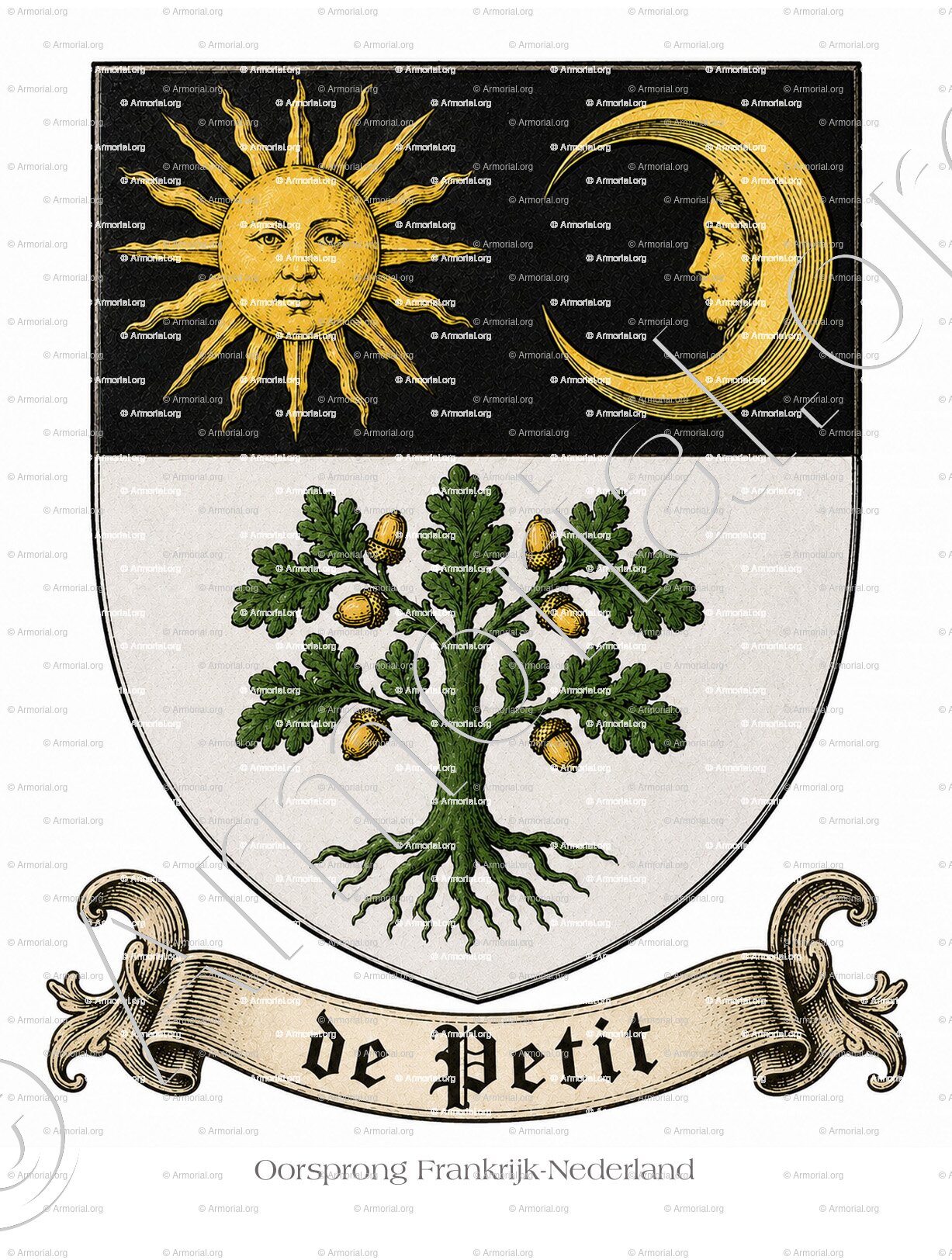
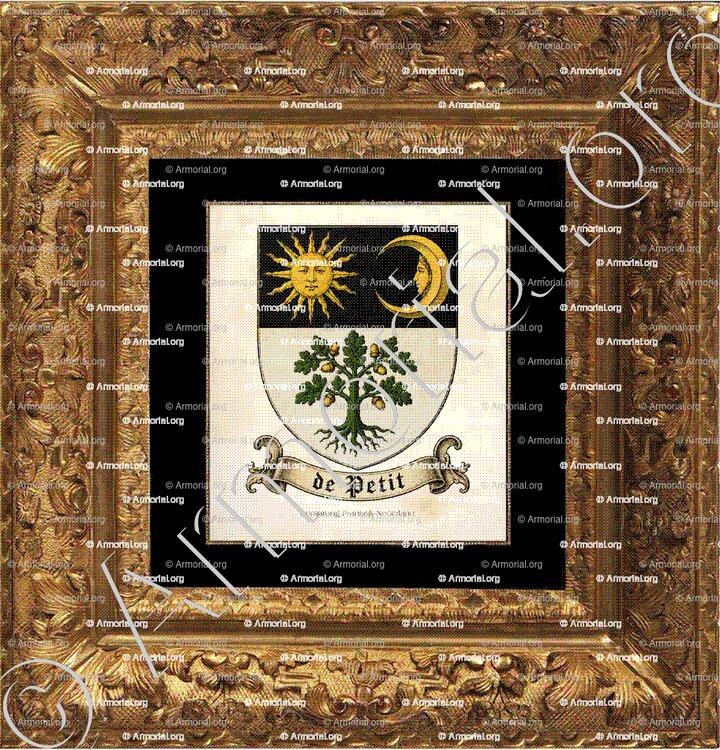
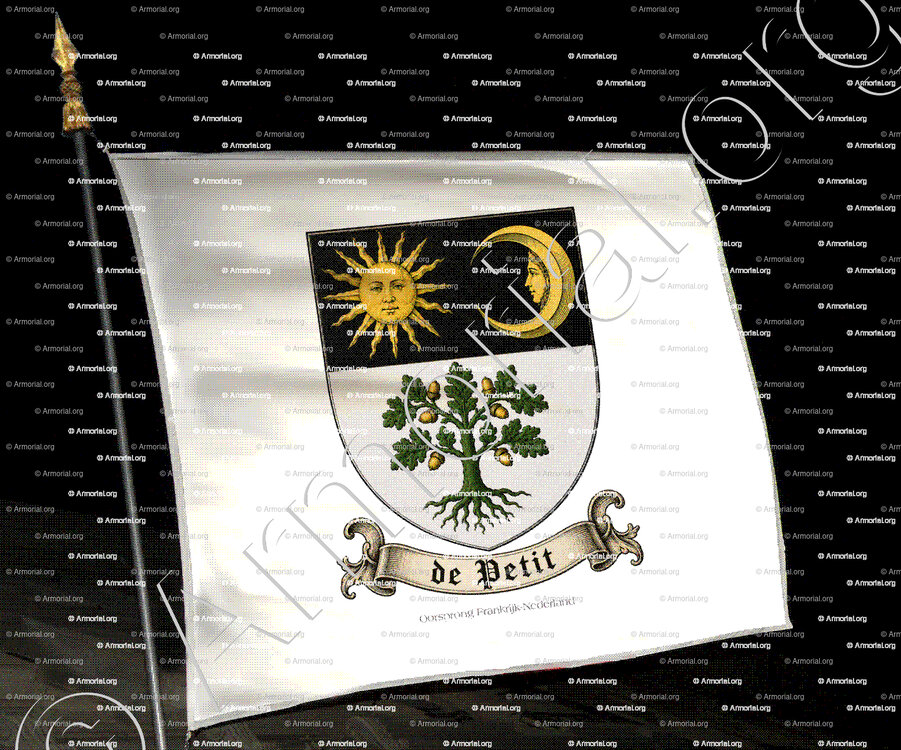
"Gedeeld: 1, in azuur (of in sabel), een gouden zon rechts en een gekeerde maansikkel van hetzelfde links; 2, in zilver, een ontwortelde eik van sinopel, beladen met gouden eikels."
✶ Heraldieke Bronnen:
Armorial d'Europe door J.B. Rietstap (Gouda, 1861, 1884, 1887; Berlijn, 1934, 1937).
Armorial général door J.B. Rietstap, geïllustreerd door Victor en Henri Rolland (1903-1926). Gekleurd door Lionel Sandoz (1993-2002).
FAMILIE DE PETIT (Frankrijk-Nederland)
✶ Geschiedenis
De familie DE PETIT is een adellijke lijn van Franse oorsprong die zich duurzaam vestigde in Nederland (Holland) aan het einde van de 18e eeuw.
In de schemering van het Ancien Régime, in een Europese context gekenmerkt door spanningen tussen monarchieën, de eerste tekenen van de Revolutie en de Napoleontische oorlogen, voerde zij reeds het wapenschild dat haar grensoverschrijdende bestemming symboliseert.
Frédéric Théophile DE PETIT, afkomstig uit Frankrijk en uit de Franse adel, was een Frans officier in dienst van de Verenigde Provinciën (Nederland). Hij werd geboren rond 1720-1730 in de regio Bergen op Zoom of Dalem, in Brabant, en overleed na 1783.
Zijn zoon, Antoine Guillaume DE PETIT (1757-1823), werd volgens sommige registers geboren in Bergen op Zoom. Hij trouwde met Adelaïde Catharina Lucia Hesselberg (1770-1820). Dit huwelijk markeert het begin van de duurzame vestiging van de familie in Nederland.
Hun zonen, met name Louis Jacob DE PETIT (1790-1853, geboren in Maastricht) en Gerrit Willem Lucas DE PETIT (1799-1851), groeiden op in de context van de Napoleontische veldtochten, terwijl de Verenigde Provinciën het Koninkrijk Holland (1806-1810) werden en vervolgens werden ingelijfd bij het Franse Keizerrijk.
De familie consolideerde haar wortels na het Congres van Wenen (1815), dat het Koninkrijk der Nederlanden creëerde. De daaropvolgende generaties, zoals Willem Louis DE PETIT (1843-1916), zetten een militaire traditie voort in dienst van de Oranjemonarchie.
De lijn doorliep vervolgens de industrialisatie van de 19e eeuw, de Nederlandse neutraliteit, de twee wereldoorlogen (met het overlijden van François Gerard Lucas DE PETIT in 1943 tijdens de Duitse bezetting) en de naoorlogse Europese opbouw.
Dit traject illustreert perfect de aanpassing van een grensoverschrijdende adel aan de grote geopolitieke omwentelingen in Europa: van het Frankrijk van het Ancien Régime tot het hedendaagse Nederland, met behoud van heraldische continuïteit (wapenschild geregistreerd bij Rietstap) en genealogische continuïteit over meer dan tweehonderdvijftig jaar.
De gewortelde eik in het wapenschild symboliseert deze duurzame verankering in Nederlandse bodem, terwijl hij het Franse licht van zijn oorsprong behoudt.
✶ Etymologie
De naam DE PETIT (of PETIT) is een zeer veelvoorkomende Franse achternaam, afkomstig van een middeleeuwse bijnaam die een persoon van kleine gestalte aanduidde of, vaker, de jongste in een broederschap (“de kleine”). Deze etymologie, gangbaar vanaf de 11e-12e eeuw, weerspiegelt een praktijk van identificatie aan de hand van fysieke of familiale kenmerken in een tijd waarin bijnamen noodzakelijk werden om individuen te onderscheiden. Het partikel “de” duidt op een adellijke of seigneuriale oorsprong die aan de naam is verbonden.
✶ Heraldiek
Het wapenschild van de familie DE PETIT (Frankrijk-Nederland) wordt als volgt beschreven:
“Gedeeld: 1, in zwart een gouden zon rechts en een naar links gewende gouden maansikkel; 2, in zilver een ontwortelde eik van groen met gouden eikels.”
Dit wapenschild komt voor in de grote Europese wapenkunde, met name in het Armorial général van J.B. Rietstap.
✶ Symboliek van het Blazoen
Het blazoen van DE PETIT is rijk aan symbolen. Het gedeelde veld verenigt twee tradities:
In het eerste kwartier (zwart) roept de gouden zon licht, glorie en de Franse oorsprong op, terwijl de (gewende) maansikkel groei, vernieuwing en mogelijk oosterse invloeden of een symbool van veerkracht suggereert.
In het tweede kwartier (zilver) symboliseert de ontwortelde eik van groen met gouden eikels kracht, langleven en duurzame verankering, met name in Nederlandse bodem. De eik staat voor stevigheid en trouw, zijn gouden eikels voor de welvaart van toekomstige generaties.
Het geheel illustreert de aanpassing van een Franse adel aan een nieuw grondgebied, terwijl zij haar lumineuze en robuuste erfgoed behoudt.
✶ Biografie van opmerkelijke personen
De genealogie van de familie DE PETIT (Frankrijk-Nederland) is opgebouwd rond een Franse adellijke lijn die zich aan het einde van de 18e eeuw en het begin van de 19e eeuw in Nederland vestigde.
Ze omvat bevestigde militaire figuren volgens Nederlandse registers en historische biografieën.
Hieronder volgt de chronologische opstelling van de belangrijkste personen, waarbij de verstrekte genealogie en de geverifieerde biografische gegevens zijn samengevoegd.
1. Frédéric Théophile DE PETIT (soms gespeld als DE PETIT), afkomstig uit een familie van de kleine Frans-Nederlandse adel met waarschijnlijk Lorraine of grensgebied-origine, werd geboren rond 1720-1730 in de regio Bergen-op-Zoom of Dalem, in Brabant (huidig Nederland). Als Frans officier in dienst van de Republiek der Zeven Verenigde Nederlanden koos hij al jong voor de wapens en klom hij geleidelijk op tot hogere rangen binnen het Nederlandse leger.
Hij trouwde met Marie-Magdelaine (of Maria Magdalena, soms vermeld als Amélie) DE PETIT, van wie de meisjesnaam onbekend blijft. Zij werd begraven op 11 april 1783 in Bergen-op-Zoom. Het begraafregister vermeldt expliciet haar echtgenoot, Anthon Frederic Theophile DE PETIT, destijds kolonel.
Uit dit huwelijk werden meerdere kinderen geboren, onder wie: Antoine Guillaume DE PETIT (1757-1823), geboren in Bergen-op-Zoom volgens de meeste registers (of in Dalem volgens bepaalde bronnen). Hij werd kapitein-majoor (kapitein-majoor) en trouwde met Adelaïde Catharina Lucia Hesselberg (1770-1820). Dit huwelijk markeert het begin van de duurzame vestiging van de Nederlandse tak van de familie. Élisabeth-Amélie DE PETIT, gedoopt in 1758 in Groningen.
Hoofdbron: West-Brabants Archief (WBA), Doop-, trouw- en begraafboeken Bergen op Zoom, begraafregister 1777-1823, folio 18.
2. Antoine Guillaume DE PETIT (soms gespeld als Antoni Willem, Antonius Willem of Guillaume DE PETIT; 1757-1823)
Afkomstig uit de kleine Frans-Nederlandse adel, werd Antoine Guillaume DE PETIT geboren in 1757, waarschijnlijk in Bergen-op-Zoom volgens meerdere registers, of in Dalem (Brabant) volgens zijn overlijdensakte. Hij is de zoon van Frédéric Théophile DE PETIT, kolonel in dienst van de Republiek der Zeven Verenigde Nederlanden, en Marie-Magdelaine (of Amélie) DE PETIT.
Hij trouwde met Adelaïde Catharina Lucia Hesselberg (soms gespeld als Alijda; 1770-1820). Dit huwelijk, gesloten in het laatste kwart van de 18e eeuw, markeert het begin van de duurzame vestiging van de Nederlandse tak van de familie, in een turbulente historische context: het einde van de Republiek der Zeven Verenigde Nederlanden, de Bataafse periode, de Franse bezetting en het Napoleontische tijdperk.
Antoine Guillaume volgde de militaire familietraditie en diende als kapitein-majoor (kapitein-majoor) in het leger. Hij overleed op 14 maart 1823 in Gendringen (Gelderland, Nederland) op 66-jarige leeftijd. Zijn overlijdensakte kwalificeert hem als “oud kapitein-majoor” en vermeldt expliciet zijn ouders: Frederic Theophile DE PETIT en Amelie DE PETIT, evenals zijn overleden echtgenote Alijda Catharina Lucia Hesselberg.
De lichte orthografische variaties in de voornamen (Antoine Guillaume / Antoni Willem / Willem) zijn geheel gebruikelijk in de tweetalige Frans-Nederlandse documenten uit die periode, waarin burgerlijke en parochieregisters afwisselden tussen Franse en Nederlandse vormen.
Antoine Guillaume DE PETIT vormt het werkelijke gedocumenteerde beginpunt van de Frans-Nederlandse tak van de familie. Uit zijn huwelijk met Adelaïde Hesselberg werden meerdere kinderen geboren, waaronder met name Willem (of Antonius Willem) DE PETIT, geboren rond 1800, die de lijn in Nederland voortzette.
Deze generatie illustreert perfect de overgang van een militaire adel van Franse oorsprong naar een definitieve verankering in de Nederlandse samenleving, terwijl een dubbele cultuur en de banden met de militaire traditie behouden bleven.
Hoofdbronnen:
Gelders Archief: overlijdensakte van 14 maart 1823 te Gendringen.
Parochieregisters (DTB) en burgerlijke stand, raadpleegbaar via WieWasWie.nl en OpenArchieven.nl.
West-Brabants Archief voor de gegevens over zijn geboorte en zijn vaderlijke familie in Bergen-op-Zoom.
3. Louis Jacob (of Louis Jacques) DE PETIT (1790-1853)
Afkomstig uit de kleine Frans-Nederlandse adel, werd Louis Jacob DE PETIT, ook wel Louis Jacques DE PETIT genoemd, geboren op 10 juli 1790 te Maastricht (Nederland). Hij was de zoon van Antoine Guillaume DE PETIT (ook wel Willem DE PETIT genoemd, oud kapitein-majoor) en Adelaïde Catharina Lucia Hesselberg (soms gespeld als Catharina Adelaide Lucie of Catharina Edeleida Hesselberg).
Opgeleid aan het kadettenkorps in Berlijn, koos hij al jong voor de militaire carrière. Hij diende eerst in het Russische leger vanaf 1809 (als vaandrig bij het 23e regiment jagers) en nam deel aan de Napoleontische veldtochten. In oktober 1815 verkreeg hij een eervol ontslag met bevordering en het recht om het uniform te blijven dragen. In januari 1816 trad hij in dienst van het Nederlandse leger.
Zijn carrière was briljant en progressief:
Luitenant in 1816, kapitein in 1818.
Lid van de commissie voor de grensafbakening tussen Nederland en Frankrijk (1820-1826).
Chef-staf van een brigade of divisie tijdens de campagne van 1830-1839 (periode van de Belgische Revolutie).
Bevorderd tot majoor in 1831, luitenant-kolonel in 1841, kolonel in 1849.
Benoemd tot generaal-majoor (generaal-majoor) op 8 september 1852 en commandant van de 4e infanteriebrigade.
Hij werd op 31 augustus 1831 onderscheiden met de Militaire Willems-Orde (4e klasse) voor zijn gedrag onder vuur. Op 3 januari 1828 trouwde hij met Florence Marie Colette van de Walle, met wie hij drie zonen kreeg.
Louis Jacob DE PETIT overleed op 26 februari 1853 te Arnhem, op 62-jarige leeftijd. Zijn overlijdensakte kwalificeert hem als “generaal majoor”. Zijn carrière illustreert perfect de post-Napoleontische overgang en de geslaagde integratie van de Frans-Nederlandse militaire elites in het Koninkrijk der Nederlanden na 1815, in dienst van het Huis van Oranje.
Deze generatie markeert de definitieve verankering van de familie in de Nederlandse samenleving en het leger, terwijl de tradities van dienstbaarheid en internationale vorming van de Franse voorouders behouden bleven.
Hoofdbronnen:
Biographisch Woordenboek der Nederlanden (A.J. van der Aa) en Nieuw Nederlandsch Biografisch Woordenboek.
Overlijdensakte van 26 februari 1853 te Arnhem (Gelders Archief).
Nekrologie in de Militaire Spectator (1853, p. 428).
Archieven raadpleegbaar via OpenArchieven.nl en WieWasWie.nl.
- Gerrit Willem Lucas DE PETIT (1799-1851)
Zoon van Antoine Guillaume DE PETIT en Adelaïde Catharina Lucia Hesselberg (mogelijk een broer of orthografische variant/naamsvariant van Louis Jacob in de documentatie). Geboren in de Napoleontische context, vestigde hij zich duurzaam in Holland en trouwde met Sara Maria Hanssen (1812-1889). Dit huwelijk symboliseert de versmelting van de Franse en Nederlandse adel na het Congres van Wenen. Hij past in de familiale trajectoire van geopolitieke herordening van Europa.
4. Willem Louis DE PETIT (1843-1916)
Afkomstig uit de kleine Frans-Nederlandse adel die stevig geworteld was in Nederland, werd Willem Louis DE PETIT geboren op 5 mei 1843 te Breda. Hij was de zoon van Louis Jacob (of Louis Jacques) DE PETIT (1790-1853), generaal-majoor in het Nederlandse leger, en Florence Marie Colette van de Walle.
Hij zette de militaire familietraditie met glans voort binnen het Koninklijk Nederlands Leger, gedurende de lange periode van neutraliteit van het Koninkrijk der Nederlanden in de 19e eeuw. Opgeleid in het kader van het hoger militair onderwijs, klom hij regelmatig op in de rangen en bereikte de graad van generaal-majoor (generaal-majoor). Hij commandeerde onder meer de IIIe militaire divisie (of IIIe militaire afdeeling) en bekleedde belangrijke verantwoordelijkheden binnen de generale staf.
Naast zijn commandofuncties onderscheidde Willem Louis DE PETIT zich als militair publicist en regelmatige medewerker van de Militaire Spectator, het toonaangevende tijdschrift van het Nederlandse leger. Hij publiceerde er verschillende artikelen en studies, waaronder in 1894 een opmerkelijke tekst ter gelegenheid van het zilveren feest (zilveren jubileum) van de Hoofdcursus (hoger militair cursus). Hij interesseerde zich ook voor strategische en historische vraagstukken, zoals blijkt uit zijn studie over de verovering van Atjeh.
Hij overleed op 22 september 1916 te Ginneken (nabij Breda), op 73-jarige leeftijd. Zijn lange carrière versterkt de definitieve verankering van de familiale tak in de Nederlandse samenleving en het militaire instituut, terwijl het erfgoed van dienstbaarheid, internationale vorming en biculturalisme van de Franse voorouders behouden bleef.
Deze generatie belichaamt de volledige integratie van de Frans-Nederlandse militaire elites in het Koninkrijk der Nederlanden van de 19e eeuw, in dienst van het Huis van Oranje, in een context van gewapende vrede en professionalisering van het leger.
Hoofdbronnen :
Registers van de burgerlijke stand: geboorteakte te Breda (5 mei 1843) en overlijdensakte te Ginneken (22 september 1916).
Archieven raadpleegbaar via OpenArchieven.nl en WieWasWie.nl.
Militaire Spectator (met name 1894, p. 667-678, en andere bijdragen).
Genealogische en militaire notices (DB Overijssel, etc.).
5. Aegidius Alexander Gerard DE PETIT (1850-1925)
Afkomstig uit de Frans-Nederlandse tak die stevig geworteld was in Nederland, werd Aegidius Alexander Gerard DE PETIT geboren op 10 februari 1850 te Bergen-op-Zoom (Brabant). Hij was de zoon van Gerrit Willem Lucas DE PETIT (of Gerrit Wilm Lucas DE PETIT), kapitein der infanterie in het Nederlandse leger, en Sara Maria Hanssen.
Hij versterkte de verankering van de familie in de Nederlandse samenleving onder de Oranjemonarchie, tijdens de periode van welvaart, neutraliteit en industrialisering van het Koninkrijk der Nederlanden in de 19e eeuw. Zijn leven omspant een tijdperk van grote stabiliteit, van het midden van het bewind van Willem III tot de eerste decennia van de 20e eeuw, vlak voor de grote mondiale omwentelingen.
Hij trouwde op 3 mei 1895 te Den Haag (’s-Gravenhage) met Jacoba Hendrika Rubenkoning (1870-1959). Dit huwelijk, gesloten toen hij 45 jaar was en zijn echtgenote 25, past in het verlengde van de burgerlijke en militaire allianties die kenmerkend zijn voor deze generatie.
Aegidius Alexander Gerard DE PETIT woonde onder meer in Amsterdam (waar hij in de Warmoesstraat verbleef in 1870-1880) voordat hij zich later vestigde in de provincie Noord-Holland. Hij overleed op 27 april 1925 te Heemstede, op 75-jarige leeftijd. Zijn overlijdensakte vermeldt expliciet zijn ouders en zijn echtgenote.
Hoewel hij minder betrokken was bij de militaire carrière dan zijn directe voorouders (Frédéric Théophile, Antoine Guillaume, Louis Jacob en Willem Louis), belichaamt hij de civiele en familiale continuïteit van de lijn. Hij droeg bij aan de definitieve verankering van de DE PETIT in de Nederlandse burgerij en samenleving aan het einde van de 19e eeuw. Zijn eventuele nakomelingen (hier niet gespecificeerd) zetten deze duurzame vestiging voort.
Deze generatie weerspiegelt de volledige assimilatie van elites van Frans-militaire oorsprong in het sociale en economische weefsel van Nederland, ver verwijderd van de Napoleontische slagvelden of de Belgische Revolutie, in een context van gewapende vrede en modernisering.
Hoofdbronnen :
Registers van de burgerlijke stand: geboorteakte van 10 februari 1850 te Bergen-op-Zoom (West-Brabants Archief).
Huwelijksakte van 3 mei 1895 te Den Haag.
Overlijdensakte van 27 april 1925 te Heemstede (Noord-Hollands Archief).
Portalen OpenArchieven.nl en WieWasWie.nl.
6. François Gérard Lucas DE PETIT (1899-1943)
Afkomstig uit de Frans-Nederlandse tak die stevig geworteld was in Nederland, werd François Gérard Lucas DE PETIT (soms gespeld als Frans Gerard Lucas DE PETIT) geboren op 20 oktober 1899 te Den Haag (Pays-Bas). Hij was de zoon van Aegidius Alexander Gerard DE PETIT (1850-1925) en Jacoba Hendrika Rubenkoning (1870-1959).
Geboren aan de vooravond van de 20e eeuw, doorleefde hij de grote crises van zijn tijd: de Eerste Wereldoorlog (toen hij een adolescent was), de economische moeilijkheden van de jaren 1920-1930, en vervolgens de oplopende internationale spanningen die leidden tot de Tweede Wereldoorlog. Hij trouwde met Pauline Alice Reichwein (1905 – na 1943). Uit dit huwelijk werd ten minste één dochter geboren, die de lijn voortzette.
François Gérard Lucas DE PETIT overleed op 10 april 1943 te Tarsao (Thailand), op 43-jarige leeftijd, tijdens de Duitse bezetting van Nederland. Zijn overlijden vond plaats in de context van de oorlog in de Stille Oceaan, vermoedelijk in verband met dwangarbeid of gevangenschap onder het Japanse regime (zoals bij veel Nederlanders die destijds in Zuidoost-Azië aanwezig waren). Hij staat vermeld op Nederlandse gedenkmonumenten voor de slachtoffers van de Tweede Wereldoorlog.
Zijn leven en tragische dood illustreren de gebroken lotgevallen van de generatie die zowel het hoogtepunt van de Nederlandse neutraliteit, de Grote Depressie als de verschrikkingen van de wereldoorlog meemaakte. Hij belichaamt de definitieve overgang van de familie naar een burgerlijk bestaan in de 20e eeuw, terwijl hij nog steeds het erfgoed van dienstbaarheid en internationale openheid droeg dat door zijn militaire voorouders was doorgegeven.
Hoofdbronnen :
Nederlandse registers van de burgerlijke stand: geboorteakte van 20 oktober 1899 te Den Haag.
Oorlogsbronnen.nl en OpenArchieven.nl (vermeldingen van overlijden te Tarsao, 10 april 1943).
Genealogische notices op Geneanet en WieWasWie.nl.
Archieven betreffende Nederlandse slachtoffers van de Tweede Wereldoorlog in Azië.
✶ Latere nakomelingen en contemporaine generatie (tweede helft van de 20e eeuw – 21e eeuw)
Uit het huwelijk van François Gérard Lucas DE PETIT (20 oktober 1899, Den Haag – 10 april 1943, Tarsao, Thailand) en Pauline Alice Reichwein (1905 – na 1943) werd ten minste één dochter geboren. Zij huwde met Duco Philibert Mees (1927-1999), zoon van Philibert Auguste Mees (1883-1971) en Klaasje Janssen (1893-1977).
Dit huwelijk, gesloten in de tweede helft van de 20e eeuw, vindt plaats in de context van de wederopbouw van Europa na 1945, de versterkte Frans-Nederlandse samenwerking en de geleidelijke integratie van burgerlijke en economische elites binnen de nieuwe Europese instellingen (Benelux, Europese Economische Gemeenschap). Het symboliseert de definitieve overgang van de familie van een militaire en nobiliaire traditie naar burgerlijke, economische en Europese sferen.
Wessel DE PETIT, zoon van een lid van de familie DE PETIT en een directe afstammeling van deze Mees – DE PETIT-unie, vertegenwoordigt de contemporaine generatie van deze lijn. Hij belichaamt, over meer dan tweeënhalve eeuw, de opmerkelijke continuïteit van een grensoverschrijdend en bicultureel erfgoed: van de kleine Franse militaire adel uit het Ancien Régime in dienst van de Republiek der Zeven Verenigde Nederlanden in de 18e eeuw, tot de definitieve verankering in de moderne Nederlandse samenleving, binnen de Europese constructie en het burgerlijke leven van het hedendaagse Nederland.
Deze tak illustreert de geleidelijke overgang van de militaire en nobiliaire traditie naar burgerlijke, economische en Europese domeinen, terwijl een familiale identiteit behouden blijft die gekenmerkt wordt door de Frans-Nederlandse dubbele cultuur en een trouw aan de waarden van dienstbaarheid, internationale openheid en veerkracht.
Hoofdbronnen :
Nederlandse registers van de burgerlijke stand (OpenArchieven.nl, WieWasWie.nl).
Archieven betreffende François Gérard Lucas DE PETIT (overlijden in Thailand in 1943 tijdens de Tweede Wereldoorlog).
Genealogische en familiale notices raadpleegbaar op Nederlandse genealogieportalen.
✶ Andere verwante of parallelle takken (minder direct)
De familie DE PETIT kent verschillende afzonderlijke takken, vaak homoniem, die de spreiding en diversiteit van de geslachten met deze achternaam in Frankrijk en Europa illustreren.
Deze takken zijn niet direct verbonden met de Frans-Nederlandse lijn die voortkomt uit Frédéric Théophile DE PETIT, maar delen soms gemeenschappelijke geografische, culturele of confessionele oorsprongen, zonder bewezen verwantschap tot op heden.
De protestantse familie DE PETIT (vermeld door Eugène en Émile Haag in La France protestante) en Étienne DE PETIT (1661-1737), huguenotenpredikant, vormen een oudere gereformeerde lijn. Deze tak getuigt van de betrokkenheid van familieleden bij het Franse protestantisme in de 17e eeuw, met lotgevallen die sterk beïnvloed werden door de Herroeping van het Edict van Nantes (1685) en een mogelijke ballingschap naar de Republiek der Zeven Verenigde Nederlanden, Engeland of andere protestantse toevluchtsoorden. Zij zou kunnen wijzen op een gemeenschappelijke gereformeerde oorsprong met de militaire Frans-Nederlandse tak, mogelijk uit Lotharingen of een grensgebied, maar de chronologische en genealogische verbinding blijft ver en niet vastgesteld.
- DE PETIT VENDIN (ingenieur, 1745-1785) betreft een technische figuur uit de 18e eeuw, waarschijnlijk actief op militair of civiel gebied (versterkingen, openbare werken). Deze tak illustreert de aanwezigheid van naamdragers in ingenieursberoepen, vaak verbonden met het leger of de staat.
- De familie PETIT de CHEMELLIER vormt een oude lijn van de Angevinse adel, met adel van extractie sinds 1418, bevestigd in 1666 en 1789. Van oorsprong uit Anjou, droeg zij de titels van vicomtes de Chemellier en barons de Blaison. Zij belichaamt de traditionele Franse landadel, met allianties en heerlijkheidsbezittingen in de regio (heerlijkheden van la Royrie, Salvert, la Pichonnière, enz.). Haar devies « Parvus sed fortis » (« Klein maar sterk ») weerspiegelt de geest van deze oude families. Er is geen directe filiatie bevestigd met de militaire Frans-Nederlandse tak.
- Deze parallelle takken benadrukken de verspreiding van de achternaam DE PETIT (of Petit) door heel Frankrijk, vaak geassocieerd met de kleine adel, militaire dienst, bestuur of vrije beroepen. Zij herinneren eraan dat homonimie een rigoureuze genealogische voorzichtigheid vereist: verschillende regionale oorsprongen (Anjou, Lotharingen, Noordelijke grenzen) en verschillende confessies (katholiek of protestant) bestaan naast elkaar zonder bewezen verband.
Een diepgaand archiefonderzoek (parochieregisters, wapenkunde, La France protestante van de gebroeders Haag, en adellijke fondsen) zou eventueel verdere verbanden of meer verre gemeenschappelijke oorsprongen kunnen vaststellen.
Hoofdbronnen :
Eugène et Émile Haag, La France protestante.
Registers van de burgerlijke stand en genealogische notices op OpenArchieven.nl, Geneanet en Franse portalen.
Wikipedia en werken over de Angevinse adel (familie Petit de Chemellier).
Franse militaire en adellijke archieven.
⚜️ © Auteursrecht : Lionel Sandoz, tekening van het wapen en tekst, 2026.
*************************
DE PETIT
Bergen op Zoom
Hollande
Pays-Bas
- Origine Lorraine (France)
✶ Armoiries :
"Coupé: au 1, de sable, à un soleil d'or à dextre, et un croissant figuré tourné du même en senestre; au 2, d'argent, à un chêne arraché de sinople, englanté d'or."
✶ Sources héraldiques :
- Armorial d'Europe par J.B. Rietstap (Gouda, 1861, 1884, 1887; Berlin, 1934, 1937).
- Armorial général J.B. Rietstap, illustré par Victor et Henri Rolland (1903-1926). Colorisé par Lionel Sandoz (1993-2002).
FAMILLE DE PETIT (France-Hollande)
✶ Historique
La famille DE PETIT est une lignée noble d’origine française qui s’est implantée durablement aux Pays-Bas (Hollande) à la fin du XVIIIe siècle.
Au crépuscule de l’Ancien Régime, dans un contexte européen marqué par les tensions entre monarchies, les prémices révolutionnaires et les guerres napoléoniennes, elle porte déjà les armoiries qui symbolisent sa destinée transfrontalière.
Frédéric Théophile DE PETIT, originaire de France et issu de la noblesse française, fut un officier français au service des Provinces-Unies (Pays-Bas). Il naquit vers 1720-1730 dans la région de Bergen-op-Zoom ou de Dalem, dans le Brabant, et mourut après 1783.
Son fils, Antoine Guillaume DE PETIT (1757-1823), naquit à Bergen-op-Zoom selon certains registres. Il épousa Adelaïde Catharina Lucia Hesselberg (1770-1820). Cette union marque le début de l’implantation durable de la famille aux Pays-Bas.
Leurs fils, notamment Louis Jacob DE PETIT (1790-1853, né à Maastricht) et Gerrit Willem Lucas DE PETIT (1799-1851), grandissent dans le contexte des campagnes napoléoniennes, alors que les Provinces-Unies deviennent Royaume de Hollande (1806-1810) puis sont intégrées à l’Empire français.
La famille consolide son enracinement après le Congrès de Vienne (1815), qui crée le Royaume des Pays-Bas. Les générations suivantes, comme Willem Louis DE PETIT (1843-1916), perpétuent une tradition militaire au service de la monarchie orangiste.
La lignée traverse ensuite l’industrialisation du XIXe siècle, la neutralité néerlandaise, les deux conflits mondiaux (avec le décès de François Gerard Lucas DE PETIT en 1943 pendant l’occupation allemande) et la construction européenne d’après-guerre.
Cette trajectoire illustre parfaitement l’adaptation d’une noblesse transfrontalière aux grands bouleversements géopolitiques européens : de la France d’Ancien Régime aux Pays-Bas contemporains, en maintenant continuité héraldique (armoiries enregistrées chez Rietstap) et généalogique sur plus de deux cent cinquante ans.
Le chêne enraciné de ses armoiries symbolise cet ancrage durable en terre hollandaise tout en conservant la lumière française de ses origines.
✶ Étymologie
Le nom DE PETIT (ou PETIT) est un patronyme français très répandu, issu d’un sobriquet médiéval désignant une personne DE PETITe taille ou, plus souvent, le plus jeune d’une fratrie (« le petit »). Cette étymologie, courante dès le XIe-XIIe siècle, reflète une pratique d’identification par caractéristiques physiques ou familiales à une époque où les surnoms devenaient nécessaires pour distinguer les individus. La particule « de » indique une origine noble ou seigneuriale associée au nom.
✶ Héraldique
Les armoiries de la famille DE PETIT (France-Hollande) sont décrites comme suit :
« Coupé : au 1, de sable, à un soleil d’or à dextre, et un croissant figuré tourné du même en senestre ; au 2, d’argent, à un chêne arraché de sinople, englanté d’or. »
Ces armoiries figurent dans les grands armoriaux européens, notamment l’Armorial général de J.B. Rietstap.
✶ Symbolique du blason
Le blason de DE PETIT est riche en symboles. Le champ coupé unit deux traditions :
- Au premier quartier (de sable), le soleil d’or évoque la lumière, la gloire et l’origine française, tandis que le croissant (tourné) suggère la croissance, le renouveau et peut-être des influences orientales ou un symbole de résilience.
- Au second quartier (d’argent), le chêne arraché de sinople, englanté d’or symbolise la force, la longévité et l’enracinement durable, particulièrement en terre hollandaise. Le chêne représente solidité et fidélité, ses glands d’or la prospérité des générations futures.
- L’ensemble illustre l’adaptation d’une noblesse française à un nouveau territoire tout en conservant son héritage lumineux et robuste.
✶ Biographique des personnages remarquables
La généalogie de la famille DE PETIT (France-Hollande) s’organise autour d’une lignée noble française implantée aux Pays-Bas à la fin du XVIIIe siècle et au début du XIXe siècle.
Elle intègre des figures militaires confirmées par les registres néerlandais et les biographies historiques.
Voici l’organisation chronologique des principaux personnages, fusionnant la généalogie fournie et les données biographiques vérifiées.
1. Frédéric Théophile DE PETIT (parfois orthographié DE PETIT), issu d’une famille de la petite noblesse franco-néerlandaise d’origine probablement lorraine ou frontalière, naquit vers 1720-1730 dans la région de Bergen-op-Zoom ou de Dalem, dans le Brabant (actuels Pays-Bas). Officier français au service des Provinces-Unies, il embrassa très jeune la carrière des armes et s’éleva progressivement aux grades supérieurs au sein de l’armée hollandaise.
Il épousa Marie-Magdelaine (ou Maria Magdalena, parfois mentionnée sous la forme Amélie) DE PETIT, dont le nom de jeune fille reste inconnu. Celle-ci fut inhumée le 11 avril 1783 à Bergen-op-Zoom. Le registre d’enterrement mentionne explicitement son époux, Anthon Frederic Theophile DE PETIT, alors kolonel (colonel).
De cette union naquirent plusieurs enfants, parmi lesquels : - Antoine Guillaume DE PETIT (1757-1823), né à Bergen-op-Zoom selon la plupart des registres (ou à Dalem selon certaines sources), qui devint capitaine-major (kapitein-majoor) et épousa Adelaïde Catharina Lucia Hesselberg (1770-1820). Cette alliance marque le début de l’implantation durable de la branche hollandaise de la famille. - Élisabeth-Amélie DE PETIT, baptisée en 1758 à Groningue.
Source principale : West-Brabants Archief (WBA), Doop-, trouw- en begraafboeken Bergen op Zoom, registre des enterrements 1777-1823, folio 18.
2. Antoine Guillaume DE PETIT (parfois orthographié Antoni Willem, Antonius Willem ou Guillaume DE PETIT ; 1757-1823)
Issu de la petite noblesse franco-néerlandaise, Antoine Guillaume DE PETIT naquit en 1757, probablement à Bergen-op-Zoom selon plusieurs registres, ou à Dalem (Brabant) selon son acte de décès. Il est le fils de Frédéric Théophile DE PETIT, colonel au service des Provinces-Unies, et de Marie-Magdelaine (ou Amélie) DE PETIT.
Il épousa Adelaïde Catharina Lucia Hesselberg (parfois orthographiée Alijda ; 1770-1820). Cette alliance, contractée dans le dernier quart du XVIIIe siècle, marque le début de l’implantation durable de la branche hollandaise de la famille, dans un contexte historique troublé : fin de la République des Provinces-Unies, période batave, occupation française et ère napoléonienne.
Antoine Guillaume suivit la tradition militaire familiale et servit comme capitaine-major (kapitein-majoor) dans l’armée. Il décéda le 14 mars 1823 à Gendringen (Gelderland, Pays-Bas), à l’âge de 66 ans. Son acte de décès le qualifie d’« ancien capitaine-major » et mentionne explicitement ses parents : Frederic Theophile DE PETIT et Amelie DE PETIT, ainsi que son épouse défunte Alijda Catharina Lucia Hesselberg.
La légère variation orthographique des prénoms (Antoine Guillaume / Antoni Willem / Willem) est tout à fait courante dans les documents bilingues franco-néerlandais de l’époque, où les actes civils et paroissiaux alternaient entre formes françaises et néerlandaises.
Antoine Guillaume DE PETIT constitue le véritable point d’origine documenté de la branche franco-hollandaise de la famille. De son union avec Adelaïde Hesselberg naquirent plusieurs enfants, dont notamment Willem (ou Antonius Willem) DE PETIT, né vers 1800, qui poursuivit la lignée aux Pays-Bas.
Cette génération illustre parfaitement la transition d’une noblesse militaire d’origine française vers une implantation définitive dans la société néerlandaise, tout en conservant une double culture et des liens avec la tradition du service des armes.
Sources principales :
Gelders Archief : acte de décès du 14 mars 1823 à Gendringen.
Registres paroissiaux (DTB) et archives civiles consultables via WieWasWie.nl et OpenArchieven.nl.
West-Brabants Archief pour les mentions liées à sa naissance et à sa famille paternelle à Bergen-op-Zoom.
3. Louis Jacob (ou Louis Jacques) DE PETIT (1790-1853)
Issu de la petite noblesse franco-néerlandaise, Louis Jacob DE PETIT, également nommé Louis Jacques DE PETIT, naquit le 10 juillet 1790 à Maastricht (Pays-Bas). Il était le fils d’Antoine Guillaume DE PETIT (dit Willem DE PETIT, ancien capitaine-major) et d’Adelaïde Catharina Lucia Hesselberg (parfois orthographiée Catharina Adelaide Lucie ou Catharina Edeleida Hesselberg).
Formé au corps des cadets à Berlin, il embrassa très jeune la carrière militaire. Il servit d’abord dans l’armée russe à partir de 1809 (comme porte-épée au 23e régiment de chasseurs), participant notamment aux campagnes napoléoniennes, avant d’obtenir un congé honorable en octobre 1815 avec élévation de grade et droit de porter l’uniforme. Il intégra ensuite l’armée néerlandaise en janvier 1816.
Sa carrière fut brillante et progressive :
Lieutenant en 1816, capitaine en 1818.
Membre de la commission de délimitation des frontières entre les Pays-Bas et la France (1820-1826).
Chef d’état-major de brigade ou de division pendant la campagne de 1830-1839 (période de la Révolution belge).
Promu major en 1831, lieutenant-colonel en 1841, colonel en 1849.
Nommé général-major (generaal-majoor) le 8 septembre 1852 et commandant de la 4e brigade d’infanterie.
Il fut décoré de la Militaire Willems-Orde (4e classe) le 31 août 1831 pour sa conduite au feu. Il épousa le 3 janvier 1828 Florence Marie Colette van de Walle, qui lui donna trois fils.
Louis Jacob DE PETIT décéda le 26 février 1853 à Arnhem, à l’âge de 62 ans. Son acte de décès le qualifie de « generaal majoor ». Sa carrière illustre parfaitement la transition post-napoléonienne et l’intégration réussie des élites militaires franco-hollandaises dans le Royaume des Pays-Bas après 1815, au service de la Maison d’Orange.
Cette génération marque l’ancrage définitif de la famille dans la société et l’armée néerlandaises, tout en conservant les traditions de service et de formation internationale héritées des ancêtres français.
Sources principales :
Biographisch Woordenboek der Nederlanden (A.J. van der Aa) et Nieuw Nederlandsch Biografisch Woordenboek.
Acte de décès du 26 février 1853 à Arnhem (Gelders Archief).
Notice nécrologique dans le Militaire Spectator (1853, p. 428).
Archives consultables via OpenArchieven.nl et WieWasWie.nl.
- Gerrit Willem Lucas DE PETIT (1799-1851)
Fils d’Antoine Guillaume DE PETIT et d’Adelaïde Catharina Lucia Hesselberg (possible frère ou variante orthographique/prénom proche de Louis Jacob dans la documentation). Né dans le contexte napoléonien, il s’implante durablement en Hollande et épouse Sara Maria Hanssen (1812-1889). Ce mariage symbolise la fusion des noblesses française et hollandaise après le Congrès de Vienne. Il s’inscrit dans la trajectoire familiale de recomposition géopolitique européenne.
4. Willem Louis DE PETIT (1843-1916)
Issu de la petite noblesse franco-néerlandaise solidement implantée aux Pays-Bas, Willem Louis DE PETIT naquit le 5 mai 1843 à Breda. Il était le fils de Louis Jacob (ou Louis Jacques) DE PETIT (1790-1853), général-major dans l’armée néerlandaise, et de Florence Marie Colette van de Walle.
Il perpétua avec éclat la tradition militaire familiale au sein de l’armée royale néerlandaise, durant la longue période de neutralité du Royaume des Pays-Bas au XIXe siècle. Formé dans le cadre de l’instruction militaire supérieure, il gravit les échelons avec régularité et atteignit le grade de général-major (generaal-majoor). Il commanda notamment la IIIe division militaire (ou IIIe militaire afdeeling) et exerça des responsabilités importantes au sein de l’état-major.
Outre ses fonctions de commandement, Willem Louis DE PETIT se distingua comme militaire publiciste et contributeur régulier au Militaire Spectator, revue de référence de l’armée néerlandaise. Il y publia plusieurs articles et études, dont notamment, en 1894, un texte marquant à l’occasion du zilveren feest (fête d’argent) du Hoofdcursus (cours supérieur militaire). Il s’intéressa aussi à des questions stratégiques et historiques, comme en témoigne son étude sur la conquête d’Aceh.
Il décéda le 22 septembre 1916 à Ginneken (près de Breda), à l’âge de 73 ans. Sa longue carrière renforce l’enracinement définitif de la branche familiale dans la société et l’institution militaire néerlandaises, tout en maintenant l’héritage de service, de formation internationale et de biculturalisme hérité des ancêtres français.
Cette génération incarne la pleine intégration des élites militaires franco-hollandaises dans le Royaume des Pays-Bas du XIXe siècle, au service de la Maison d’Orange, dans un contexte de paix armée et de professionnalisation de l’armée.
Sources principales :
Registres d’état civil : acte de naissance à Breda (5 mai 1843) et acte de décès à Ginneken (22 septembre 1916).
Archives consultables via OpenArchieven.nl et WieWasWie.nl.
Militaire Spectator (notamment 1894, p. 667-678, et autres contributions).
Notices généalogiques et militaires (DB Overijssel, etc.).
5. Aegidius Alexander Gerard DE PETIT (1850-1925)
Issu de la branche franco-néerlandaise solidement implantée aux Pays-Bas, Aegidius Alexander Gerard DE PETIT naquit le 10 février 1850 à Bergen-op-Zoom (Brabant). Il était le fils de Gerrit Willem Lucas DE PETIT (ou Gerrit Wilm Lucas DE PETIT), capitaine d’infanterie dans l’armée néerlandaise, et de Sara Maria Hanssen.
Il consolida l’enracinement de la famille dans la société néerlandaise sous la monarchie orangiste, durant la période de prospérité, de neutralité et d’industrialisation du Royaume des Pays-Bas au XIXe siècle. Sa vie couvre une époque de grande stabilité, depuis le milieu du règne de Guillaume III jusqu’aux premières décennies du XXe siècle, juste avant les grands bouleversements mondiaux.
Il épousa le 3 mai 1895 à La Haye (’s-Gravenhage) Jacoba Hendrika Rubenkoning (1870-1959). Cette union, contractée alors qu’il avait 45 ans et son épouse 25 ans, s’inscrit dans le prolongement des alliances bourgeoises et militaires qui caractérisent cette génération.
Aegidius Alexander Gerard DE PETIT vécut notamment à Amsterdam (où il résidait Warmoesstraat en 1870-1880) avant de s’installer plus tard dans la province de Hollande-Septentrionale. Il décéda le 27 avril 1925 à Heemstede, à l’âge de 75 ans. Son acte de décès mentionne explicitement ses parents et son épouse.
Bien que moins engagé dans la carrière militaire que ses ancêtres directs (Frédéric Théophile, Antoine Guillaume, Louis Jacob et Willem Louis), il incarne la continuité civile et familiale de la lignée, participant à l’ancrage définitif des DE PETIT dans la bourgeoisie et la société néerlandaises du XIXe siècle finissant. Sa descendance éventuelle (non précisée ici) prolongea cette implantation durable.
Cette génération reflète la pleine assimilation des élites d’origine franco-militaire dans le tissu social et économique des Pays-Bas, loin des champs de bataille napoléoniens ou de la Révolution belge, dans un contexte de paix armée et de modernisation.
Sources principales :
Registres d’état civil : acte de naissance du 10 février 1850 à Bergen-op-Zoom (West-Brabants Archief).
Acte de mariage du 3 mai 1895 à La Haye.
Acte de décès du 27 avril 1925 à Heemstede (Noord-Hollands Archief).
Portails OpenArchieven.nl et WieWasWie.nl.
6. François Gérard Lucas DE PETIT (1899-1943)
Issu de la branche franco-néerlandaise solidement implantée aux Pays-Bas, François Gérard Lucas DE PETIT (parfois orthographié Frans Gerard Lucas DE PETIT) naquit le 20 octobre 1899 à La Haye (Den Haag, Pays-Bas). Il était le fils d’Aegidius Alexander Gerard DE PETIT (1850-1925) et de Jacoba Hendrika Rubenkoning (1870-1959).
Né à l’aube du XXe siècle, il traversa les grandes crises de son époque : la Première Guerre mondiale (alors qu’il était adolescent), les difficultés économiques des années 1920-1930, puis la montée des tensions internationales menant à la Seconde Guerre mondiale. Il épousa Pauline Alice Reichwein (1905 – après 1943). De cette union naquirent au moins une fille, qui perpétua la lignée.
François Gérard Lucas DE PETIT décéda le 10 avril 1943 à Tarsao (Thaïlande), à l’âge de 43 ans, pendant l’occupation allemande des Pays-Bas. Son décès intervint dans le contexte de la guerre du Pacifique, vraisemblablement en lien avec des travaux forcés ou des conditions de captivité liées au régime japonais (comme de nombreux Néerlandais présents en Asie du Sud-Est à cette époque). Il est inscrit sur les monuments commémoratifs néerlandais relatifs aux victimes de la Seconde Guerre mondiale.
Sa vie et sa mort tragique illustrent les destins brisés de la génération qui connut à la fois l’apogée de la neutralité néerlandaise, la Grande Dépression et les horreurs de la guerre mondiale. Il incarne la transition définitive de la famille vers une existence civile au XXe siècle, tout en portant encore l’héritage du service et de l’ouverture internationale transmis par ses ancêtres militaires.
Sources principales :
Registres d’état civil néerlandais : acte de naissance du 20 octobre 1899 à La Haye.
Oorlogsbronnen.nl et OpenArchieven.nl (mentions de décès à Tarsao, 10 avril 1943).
Notices généalogiques sur Geneanet et WieWasWie.nl.
Archives relatives aux victimes néerlandaises de la Seconde Guerre mondiale en Asie.
✶ Descendance ultérieure et génération contemporaine (seconde moitié du XXe siècle – XXIe siècle)
De l’union de François Gérard Lucas DE PETIT (20 octobre 1899, La Haye – 10 avril 1943, Tarsao, Thaïlande) et de Pauline Alice Reichwein (1905 – après 1943) naquit au moins une fille. Celle-ci s’unit à Duco Philibert Mees (1927-1999), fils de Philibert Auguste Mees (1883-1971) et de Klaasje Janssen (1893-1977).
Ce mariage, célébré dans la seconde moitié du XXe siècle, s’inscrit dans le contexte de la reconstruction de l’Europe après 1945, de la coopération franco-néerlandaise renforcée et de l’intégration progressive des élites civiles et économiques au sein des nouvelles institutions européennes (Benelux, Communauté économique européenne). Il symbolise le passage définitif de la famille d’une tradition militaire et nobiliaire vers des sphères civiles, économiques et européennes.
Wessel DE PETIT, fils d’un membre de la famille DE PETIT et d’une descendante directe de cette union Mees – DE PETIT, représente la génération contemporaine de cette lignée. Il incarne, sur plus de deux cent cinquante ans, la remarquable continuité d’un héritage transfrontalier et biculturel : de la petite noblesse militaire française d’Ancien Régime, au service des Provinces-Unies au XVIIIe siècle, jusqu’à l’ancrage définitif dans la société néerlandaise moderne, au sein de la construction européenne et de la vie civile des Pays-Bas contemporains.
Cette branche illustre la transition progressive de la tradition militaire et nobiliaire vers des sphères civiles, économiques et européennes, tout en conservant une identité familiale marquée par la double culture franco-néerlandaise et une fidélité aux valeurs de service, d’ouverture internationale et de résilience.
Sources principales :
Registres d’état civil néerlandais (OpenArchieven.nl, WieWasWie.nl).
Archives relatives à François Gérard Lucas DE PETIT (décès en Thaïlande en 1943 pendant la Seconde Guerre mondiale).
Notices généalogiques et familiales consultables sur les portails de généalogie néerlandais.
✶ Autres branches connexes ou parallèles (moins directes)
La famille DE PETIT présente plusieurs branches distinctes, souvent homonymes, qui illustrent la dispersion et la diversité des lignées portant ce patronyme en France et en Europe.
Ces branches ne sont pas directement rattachées à la lignée franco-néerlandaise issue de Frédéric Théophile DE PETIT, mais elles partagent parfois des origines géographiques, culturelles ou confessionnelles communes, sans filiation prouvée à ce jour.
La famille protestante DE PETIT (mentionnée par Eugène et Émile Haag dans La France protestante) et Étienne DE PETIT (1661-1737), pasteur huguenot, représentent une lignée réformée plus ancienne. Cette branche témoigne de l’implication de membres de la famille dans le protestantisme français au XVIIe siècle, avec des destins marqués par la Révocation de l’édit de Nantes (1685) et l’exil possible vers les Provinces-Unies, l’Angleterre ou d’autres refuges protestants. Elle pourrait suggérer une origine réformée commune avec la branche militaire franco-néerlandaise, potentiellement lorraine ou frontalière, mais la connexion chronologique et généalogique reste éloignée et non établie.
- DE PETIT VENDIN (ingénieur, 1745-1785) correspond à une figure technique du XVIIIe siècle, probablement active dans le domaine militaire ou civil (fortifications, travaux publics). Cette branche illustre la présence de porteurs du nom dans des professions d’ingénierie, souvent liées aux armées ou à l’État.
- La famille PETIT de CHEMELLIER constitue une ancienne lignée de la noblesse angevine, de noblesse d’extraction remontant à 1418, maintenue noble en 1666 et 1789. Originaire d’Anjou, elle porta les titres de vicomtes de Chemellier et barons de Blaison. Elle incarne la noblesse terrienne française traditionnelle, avec des alliances et des possessions seigneuriales dans la région (seigneuries de la Royrie, de Salvert, de la Pichonnière, etc.). Sa devise « Parvus sed fortis » (« Petit mais fort ») reflète l’esprit de ces familles anciennes. Aucune filiation directe n’est confirmée avec la branche militaire franco-néerlandaise.
- Ces branches parallèles soulignent la diffusion du patronyme DE PETIT (ou Petit) à travers la France, souvent associé à la petite noblesse, au service militaire, à l’administration ou aux professions libérales. Elles rappellent que l’homonymie nécessite une prudence généalogique rigoureuse : des origines régionales variées (Anjou, Lorraine, frontières du Nord) et des confessions différentes (catholique ou protestante) coexistent sans lien avéré.
L’étude approfondie des archives (registres paroissiaux, armoriaux, La France protestante des frères Haag, et fonds nobiliaires) permettrait éventuellement d’établir des rapprochements ou des origines communes plus lointaines.
Sources principales :
Eugène et Émile Haag, La France protestante.
Registres d’état civil et notices généalogiques sur OpenArchieven.nl, Geneanet et portails français.
Wikipédia et ouvrages sur la noblesse angevine (famille Petit de Chemellier).
Archives militaires et nobiliaires françaises.
⚜️ © Droits d'auteur : Lionel Sandoz, dessin des armoiries et texte, 2026.
********************
DE PETIT
Bergen op Zoom
Holland
The Netherlands
Origin: Lorraine (France)
✶ Coat of Arms / Blazon:
"Per fess: 1st, Azure (or Sable), a sun Or to the dexter and a figured crescent turned of the same to the sinister; 2nd, Argent, an oak tree eradicated Vert, acorned Or."
✶ Heraldic Sources:
Armorial d'Europe by J.B. Rietstap (Gouda, 1861, 1884, 1887; Berlin, 1934, 1937).
Armorial général by J.B. Rietstap, illustrated by Victor and Henri Rolland (1903-1926). Coloured by Lionel Sandoz (1993-2002).
DE PETIT FAMILY (France-Netherlands)
✶ History
The DE PETIT family is a noble lineage of French origin that established itself permanently in the Netherlands (Holland) at the end of the 18th century.
At the twilight of the Ancien Régime, in a European context marked by tensions between monarchies, the beginnings of the Revolution and the Napoleonic Wars, it already bore the coat of arms that symbolise its cross-border destiny.
Frédéric Théophile DE PETIT, originally from France and from the French nobility, was a French officer in the service of the United Provinces (Netherlands). He was born around 1720-1730 in the region of Bergen-op-Zoom or Dalem, in Brabant, and died after 1783.
His son, Antoine Guillaume DE PETIT (1757-1823), was born in Bergen-op-Zoom according to certain registers. He married Adelaïde Catharina Lucia Hesselberg (1770-1820). This union marks the beginning of the family’s lasting establishment in the Netherlands.
Their sons, notably Louis Jacob DE PETIT (1790-1853, born in Maastricht) and Gerrit Willem Lucas DE PETIT (1799-1851), grew up during the Napoleonic campaigns, while the United Provinces became the Kingdom of Holland (1806-1810) and were then incorporated into the French Empire.
The family consolidated its roots after the Congress of Vienna (1815), which created the Kingdom of the Netherlands. Subsequent generations, such as Willem Louis DE PETIT (1843-1916), continued a military tradition in the service of the Orange monarchy.
The lineage then lived through the industrialisation of the 19th century, Dutch neutrality, the two World Wars (with the death of François Gerard Lucas DE PETIT in 1943 during the German occupation) and post-war European construction.
This trajectory perfectly illustrates the adaptation of a cross-border nobility to the major geopolitical upheavals in Europe: from Ancien Régime France to the contemporary Netherlands, while maintaining heraldic continuity (arms recorded by Rietstap) and genealogical continuity for more than two hundred and fifty years.
The rooted oak in its coat of arms symbolises this lasting anchorage in Dutch soil while preserving the French light of its origins.
✶ Etymology
The name DE PETIT (or PETIT) is a very common French surname, derived from a medieval nickname designating a person of small stature or, more often, the youngest in a sibling group (“the little one”). This etymology, common as early as the 11th-12th centuries, reflects the practice of identification by physical or family characteristics at a time when surnames became necessary to distinguish individuals. The particle “de” indicates a noble or seigneurial origin associated with the name.
✶ Heraldry
The coat of arms of the DE PETIT family (France-Netherlands) is described as follows:
“Coupé: 1st, sable, a sun in splendour or to the dexter, and a crescent turned of the same to the sinister; 2nd, argent, an oak tree eradicated vert, acorned or.”
These arms appear in the major European armorials, notably the Armorial général of J.B. Rietstap.
✶ Symbolism of the Blazon
The DE PETIT coat of arms is rich in symbolism. The divided field unites two traditions:
In the first quarter (sable), the golden sun evokes light, glory and the French origin, while the turned crescent suggests growth, renewal and possibly oriental influences or a symbol of resilience.
In the second quarter (argent), the eradicated oak vert, acorned or, symbolises strength, longevity and lasting rooting, particularly in Dutch soil. The oak represents solidity and fidelity, its golden acorns the prosperity of future generations.
The whole illustrates the adaptation of a French nobility to a new territory while preserving its luminous and robust heritage.
✶ Biographies of Remarkable Figures
The genealogy of the DE PETIT family (France-Netherlands) is centred around a French noble lineage that settled in the Netherlands at the end of the 18th century and the beginning of the 19th century.
It includes confirmed military figures documented in Dutch registers and historical biographies.
Here is a chronological presentation of the main individuals, combining the provided genealogy with verified biographical data.
1. Frédéric Théophile DE PETIT (sometimes spelled DE PETIT), from a family of minor Franco-Dutch nobility probably of Lorraine or border-region origin, was born around 1720–1730 in the area of Bergen-op-Zoom or Dalem, in Brabant (present-day Netherlands). A French officer in the service of the United Provinces, he embarked on a military career at a very young age and gradually rose through the ranks in the Dutch army.
He married Marie-Magdelaine (or Maria Magdalena, sometimes referred to as Amélie) DE PETIT, whose maiden name remains unknown. She was buried on 11 April 1783 in Bergen-op-Zoom. The burial register explicitly mentions her husband, Anthon Frederic Theophile DE PETIT, then a kolonel (colonel).
This union produced several children, including: Antoine Guillaume DE PETIT (1757–1823), born in Bergen-op-Zoom according to most registers (or in Dalem according to certain sources), who became a captain-major (kapitein-majoor) and married Adelaïde Catharina Lucia Hesselberg (1770–1820). This marriage marks the beginning of the lasting establishment of the Dutch branch of the family.
Élisabeth-Amélie DE PETIT, baptised in 1758 in Groningen.
Main source: West-Brabants Archief (WBA), Doop-, trouw- en begraafboeken Bergen op Zoom, burial register 1777–1823, folio 18.
2. Antoine Guillaume DE PETIT (sometimes spelled Antoni Willem, Antonius Willem or Guillaume DE PETIT; 1757–1823)
From the minor Franco-Dutch nobility, Antoine Guillaume DE PETIT was born in 1757, probably in Bergen-op-Zoom according to several registers, or in Dalem (Brabant) according to his death certificate. He was the son of Frédéric Théophile DE PETIT, colonel in the service of the United Provinces, and Marie-Magdelaine (or Amélie) DE PETIT.
He married Adelaïde Catharina Lucia Hesselberg (sometimes spelled Alijda; 1770–1820). This union, contracted in the last quarter of the 18th century, marks the beginning of the lasting establishment of the Dutch branch of the family, in a turbulent historical context: the end of the Republic of the Seven United Provinces, the Batavian period, French occupation and the Napoleonic era.
Antoine Guillaume followed the family military tradition and served as captain-major (kapitein-majoor) in the army. He died on 14 March 1823 in Gendringen (Gelderland, Netherlands) at the age of 66. His death certificate describes him as a “former captain-major” and explicitly mentions his parents: Frederic Theophile DE PETIT and Amelie DE PETIT, as well as his deceased wife Alijda Catharina Lucia Hesselberg.
The slight orthographic variations in first names (Antoine Guillaume / Antoni Willem / Willem) are quite common in bilingual Franco-Dutch documents of the period, where civil and parish records alternated between French and Dutch forms.
Antoine Guillaume DE PETIT constitutes the true documented starting point of the Franco-Dutch branch of the family. His union with Adelaïde Hesselberg produced several children, notably Willem (or Antonius Willem) DE PETIT, born around 1800, who continued the lineage in the Netherlands.
This generation perfectly illustrates the transition of a military nobility of French origin towards a permanent integration into Dutch society, while preserving a dual culture and ties to the tradition of military service.
Main sources:
Gelders Archief: death certificate of 14 March 1823 in Gendringen.
Parish registers (DTB) and civil archives available via WieWasWie.nl and OpenArchieven.nl.
West-Brabants Archief for references to his birth and paternal family in Bergen-op-Zoom.
3. Louis Jacob (or Louis Jacques) DE PETIT (1790–1853)
From the minor Franco-Dutch nobility, Louis Jacob DE PETIT, also known as Louis Jacques DE PETIT, was born on 10 July 1790 in Maastricht (Netherlands). He was the son of Antoine Guillaume DE PETIT (known as Willem DE PETIT, former captain-major) and Adelaïde Catharina Lucia Hesselberg (sometimes spelled Catharina Adelaide Lucie or Catharina Edeleida Hesselberg).
Trained at the cadet corps in Berlin, he embarked on a military career at a very young age. He first served in the Russian army from 1809 (as an ensign in the 23rd Chasseur Regiment), notably participating in the Napoleonic campaigns, before receiving an honourable discharge in October 1815 with promotion and the right to wear the uniform. He then joined the Dutch army in January 1816.
His career was brilliant and progressive:
Lieutenant in 1816, captain in 1818.
Member of the border demarcation commission between the Netherlands and France (1820–1826).
Chief of staff of a brigade or division during the 1830–1839 campaign (period of the Belgian Revolution).
Promoted to major in 1831, lieutenant-colonel in 1841, and colonel in 1849.
Appointed major-general (generaal-majoor) on 8 September 1852 and commander of the 4th Infantry Brigade.
He was decorated with the Military Order of William (4th class) on 31 August 1831 for his conduct under fire. He married Florence Marie Colette van de Walle on 3 January 1828, with whom he had three sons.
Louis Jacob DE PETIT died on 26 February 1853 in Arnhem at the age of 62. His death certificate describes him as a “generaal majoor”. His career perfectly illustrates the post-Napoleonic transition and the successful integration of Franco-Dutch military elites into the Kingdom of the Netherlands after 1815, in the service of the House of Orange.
This generation marks the definitive anchoring of the family in Dutch society and the army, while preserving the traditions of service and international training inherited from their French ancestors.
Main sources:
Biographisch Woordenboek der Nederlanden (A.J. van der Aa) and Nieuw Nederlandsch Biografisch Woordenboek.
Death certificate of 26 February 1853 in Arnhem (Gelders Archief).
Obituary in the Militaire Spectator (1853, p. 428).
Archives available via OpenArchieven.nl and WieWasWie.nl.
- Gerrit Willem Lucas DE PETIT (1799–1851)
Son of Antoine Guillaume DE PETIT and Adelaïde Catharina Lucia Hesselberg (possible brother or orthographic/prename variant of Louis Jacob in the records). Born in the Napoleonic context, he settled permanently in Holland and married Sara Maria Hanssen (1812–1889). This marriage symbolises the fusion of French and Dutch nobilities after the Congress of Vienna. He fits into the family trajectory of European geopolitical recomposition.
4. Willem Louis DE PETIT (1843–1916)
From the minor Franco-Dutch nobility firmly established in the Netherlands, Willem Louis DE PETIT was born on 5 May 1843 in Breda. He was the son of Louis Jacob (or Louis Jacques) DE PETIT (1790–1853), major-general in the Dutch army, and Florence Marie Colette van de Walle.
He brilliantly perpetuated the family military tradition within the Royal Dutch Army during the Kingdom of the Netherlands’ long period of neutrality in the 19th century. Trained through advanced military education, he steadily climbed the ranks and reached the grade of major-general (generaal-majoor). He notably commanded the IIIrd Military Division (IIIe militaire afdeeling) and held important staff responsibilities.
In addition to his command duties, Willem Louis DE PETIT distinguished himself as a military publicist and regular contributor to the Militaire Spectator, the leading journal of the Dutch army. He published several articles and studies there, including a notable text in 1894 on the occasion of the zilveren feest (silver jubilee) of the Hoofdcursus (Advanced Military Course). He also took an interest in strategic and historical issues, as evidenced by his study on the conquest of Aceh.
He died on 22 September 1916 in Ginneken (near Breda) at the age of 73. His long career further strengthened the definitive rooting of the family branch in Dutch society and the military institution, while maintaining the heritage of service, international training, and biculturalism inherited from his French ancestors.
This generation embodies the full integration of Franco-Dutch military elites into the 19th-century Kingdom of the Netherlands, in the service of the House of Orange, in a context of armed peace and professionalisation of the army.
Main sources:
Civil registry records: birth certificate in Breda (5 May 1843) and death certificate in Ginneken (22 September 1916).
Archives available via OpenArchieven.nl and WieWasWie.nl.
Militaire Spectator (notably 1894, pp. 667–678, and other contributions).
Genealogical and military records (DB Overijssel, etc.).
5. Aegidius Alexander Gerard DE PETIT (1850–1925)
From the Franco-Dutch branch firmly established in the Netherlands, Aegidius Alexander Gerard DE PETIT was born on 10 February 1850 in Bergen-op-Zoom (Brabant). He was the son of Gerrit Willem Lucas DE PETIT (or Gerrit Wilm Lucas DE PETIT), infantry captain in the Dutch army, and Sara Maria Hanssen.
He consolidated the family’s deep roots in Dutch society under the Orange monarchy, during the period of prosperity, neutrality, and industrialisation of the Kingdom of the Netherlands in the 19th century. His life spans an era of great stability, from the middle of William III’s reign to the first decades of the 20th century, just before the major global upheavals.
He married Jacoba Hendrika Rubenkoning (1870–1959) on 3 May 1895 in The Hague (’s-Gravenhage). This union, contracted when he was 45 and his wife 25, continues the pattern of bourgeois and military alliances characteristic of this generation.
Aegidius Alexander Gerard DE PETIT lived notably in Amsterdam (where he resided on Warmoesstraat between 1870 and 1880) before later settling in the province of North Holland. He died on 27 April 1925 in Heemstede at the age of 75. His death certificate explicitly mentions his parents and his wife.
Although less engaged in a military career than his direct ancestors (Frédéric Théophile, Antoine Guillaume, Louis Jacob, and Willem Louis), he embodies the civil and familial continuity of the lineage, contributing to the definitive anchoring of the DE PETIT family within the Dutch bourgeoisie and society at the end of the 19th century. His possible descendants (not specified here) extended this lasting establishment.
This generation reflects the full assimilation of elites of Franco-military origin into the social and economic fabric of the Netherlands, far removed from the Napoleonic battlefields or the Belgian Revolution, in a context of armed peace and modernisation.
Main sources:
Civil registry records: birth certificate of 10 February 1850 in Bergen-op-Zoom (West-Brabants Archief).
Marriage certificate of 3 May 1895 in The Hague.
Death certificate of 27 April 1925 in Heemstede (Noord-Hollands Archief).
Portals OpenArchieven.nl and WieWasWie.nl.
6. François Gérard Lucas DE PETIT (1899–1943)
From the Franco-Dutch branch firmly established in the Netherlands, François Gérard Lucas DE PETIT (sometimes spelled Frans Gerard Lucas DE PETIT) was born on 20 October 1899 in The Hague (Den Haag, Netherlands). He was the son of Aegidius Alexander Gerard DE PETIT (1850–1925) and Jacoba Hendrika Rubenkoning (1870–1959).
Born at the dawn of the 20th century, he lived through the major crises of his time: the First World War (as a teenager), the economic difficulties of the 1920s–1930s, and then the rising international tensions leading to the Second World War. He married Pauline Alice Reichwein (1905 – after 1943). This union produced at least one daughter, who continued the lineage.
François Gérard Lucas DE PETIT died on 10 April 1943 in Tarsao (Thailand) at the age of 43, during the German occupation of the Netherlands. His death occurred in the context of the Pacific War, most likely linked to forced labour or captivity conditions under the Japanese regime (as was the case for many Dutch people present in Southeast Asia at the time). He is listed on Dutch commemorative monuments for victims of the Second World War.
His life and tragic death illustrate the broken destinies of the generation that experienced both the peak of Dutch neutrality, the Great Depression, and the horrors of world war. He embodies the family’s definitive transition to civilian life in the 20th century, while still carrying the heritage of service and international openness passed down by his military ancestors.
Main sources:
Dutch civil registry records: birth certificate of 20 October 1899 in The Hague.
Oorlogsbronnen.nl and OpenArchieven.nl (mentions of death in Tarsao, 10 April 1943).
Genealogical records on Geneanet and WieWasWie.nl.
Archives concerning Dutch victims of the Second World War in Asia.
✶ Later Descendants and Contemporary Generation (Second Half of the 20th Century – 21st Century)
From the union of François Gérard Lucas DE PETIT (20 October 1899, The Hague – 10 April 1943, Tarsao, Thailand) and Pauline Alice Reichwein (1905 – after 1943) was born at least one daughter. She married Duco Philibert Mees (1927–1999), son of Philibert Auguste Mees (1883–1971) and Klaasje Janssen (1893–1977).
This marriage, celebrated in the second half of the 20th century, took place in the context of Europe’s reconstruction after 1945, strengthened Franco-Dutch cooperation, and the gradual integration of civilian and economic elites into the new European institutions (Benelux, European Economic Community). It symbolises the family’s definitive shift from a military and noble tradition into civilian, economic, and European spheres.
Wessel DE PETIT, son of a member of the DE PETIT family and a direct descendant of this Mees – DE PETIT union, represents the contemporary generation of this lineage. Over more than two hundred and fifty years, he embodies the remarkable continuity of a cross-border and bicultural heritage: from the minor French military nobility of the Ancien Régime, serving the United Provinces in the 18th century, to its definitive anchoring in modern Dutch society, within the framework of European construction and contemporary Dutch civilian life.
This branch illustrates the gradual transition from a military and noble tradition into civilian, economic, and European spheres, while retaining a family identity marked by Franco-Dutch dual culture and fidelity to the values of service, international openness, and resilience.
Main sources:
Dutch civil registry records (OpenArchieven.nl, WieWasWie.nl).
Archives relating to François Gérard Lucas DE PETIT (death in Thailand in 1943 during the Second World War).
Genealogical and family records available on Dutch genealogy portals.
✶ Other Related or Parallel Branches (Less Direct)
The DE PETIT family includes several distinct branches, often homonymous, which illustrate the dispersion and diversity of lineages bearing this surname in France and Europe.
These branches are not directly connected to the Franco-Dutch lineage descending from Frédéric Théophile DE PETIT, but they sometimes share common geographical, cultural, or religious origins, without any proven filiation to date.
The Protestant DE PETIT family (mentioned by Eugène and Émile Haag in La France protestante) and Étienne DE PETIT (1661–1737), a Huguenot pastor, represent an older Reformed lineage. This branch bears witness to the involvement of family members in French Protestantism in the 17th century, with destinies marked by the Revocation of the Edict of Nantes (1685) and possible exile to the United Provinces, England, or other Protestant refuges. It could suggest a common Reformed origin with the Franco-Dutch military branch, potentially Lorraine or border-region, but the chronological and genealogical connection remains distant and unestablished.
- DE PETIT VENDIN (engineer, 1745–1785) corresponds to a technical figure of the 18th century, probably active in the military or civil domain (fortifications, public works). This branch illustrates the presence of name-bearers in engineering professions, often linked to the armies or the State.
The PETIT de CHEMELLIER family constitutes an ancient lineage of Angevin nobility, with nobility of extraction dating back to 1418, confirmed in 1666 and 1789. Originating from Anjou, it held the titles of Viscounts of Chemellier and Barons of Blaison. It embodies traditional French landed nobility, with alliances and seigneurial possessions in the region (seigneuries of La Royrie, Salvert, La Pichonnière, etc.). Its motto “Parvus sed fortis” (“Small but strong”) reflects the spirit of these ancient families. No direct filiation has been confirmed with the Franco-Dutch military branch.
These parallel branches highlight the spread of the surname DE PETIT (or Petit) across France, often associated with minor nobility, military service, administration, or liberal professions. They serve as a reminder that homonymy requires rigorous genealogical caution: varied regional origins (Anjou, Lorraine, Northern borders) and different confessions (Catholic or Protestant) coexist without established links.
An in-depth study of the archives (parish registers, armorials, La France protestante by the Haag brothers, and noble fonds) could potentially establish closer connections or more distant common origins.
Main sources:
Eugène and Émile Haag, La France protestante.
Civil registry records and genealogical notices on OpenArchieven.nl, Geneanet, and French portals.
Wikipedia and works on Angevin nobility (Petit de Chemellier family).
French military and noble archives.
⚜️ © Copyright: Lionel Sandoz, coat of arms design and text, 2026.
****************************
PARTAGEZ SUR LES RÉSEAUX SOCIAUX
LES AVIS
Il n'y a aucune note pour le moment. Soyez le premier à évaluer !
DONNEZ UNE NOTE