
DESCRIPTION
⚜️ DEMEROVIĆ vs. DEMIROVIĆ
ДЕМЕРОВИЋ (Демеровић) vs. ДЕМИРОВИЋ (Демировић) (cyrillique serbe/bosniaque)
Bosnie-Herzégovine, Croatie, Serbie.
Empires ottoman et austro-hongrois.
Nom de famille slavo-musulman typique des populations bosniaques, serbes musulmanes ou monténégrines islamisées.
Originaire de Kulen Vakuf, Bijeljina, Kola (près de Banja Luka) et Vlasenica.
Une terre dite « zemlja eno Demerović » est mentionnée dans l’ouvrage ethnographique d’Ivo Šajnović Kola (Život i običaji plemena Kuča, 1901).
Famille entrée dans la notabilité balkanique sous l’Empire ottoman (XVe–XIXe siècle).
⚜️ Armoiries
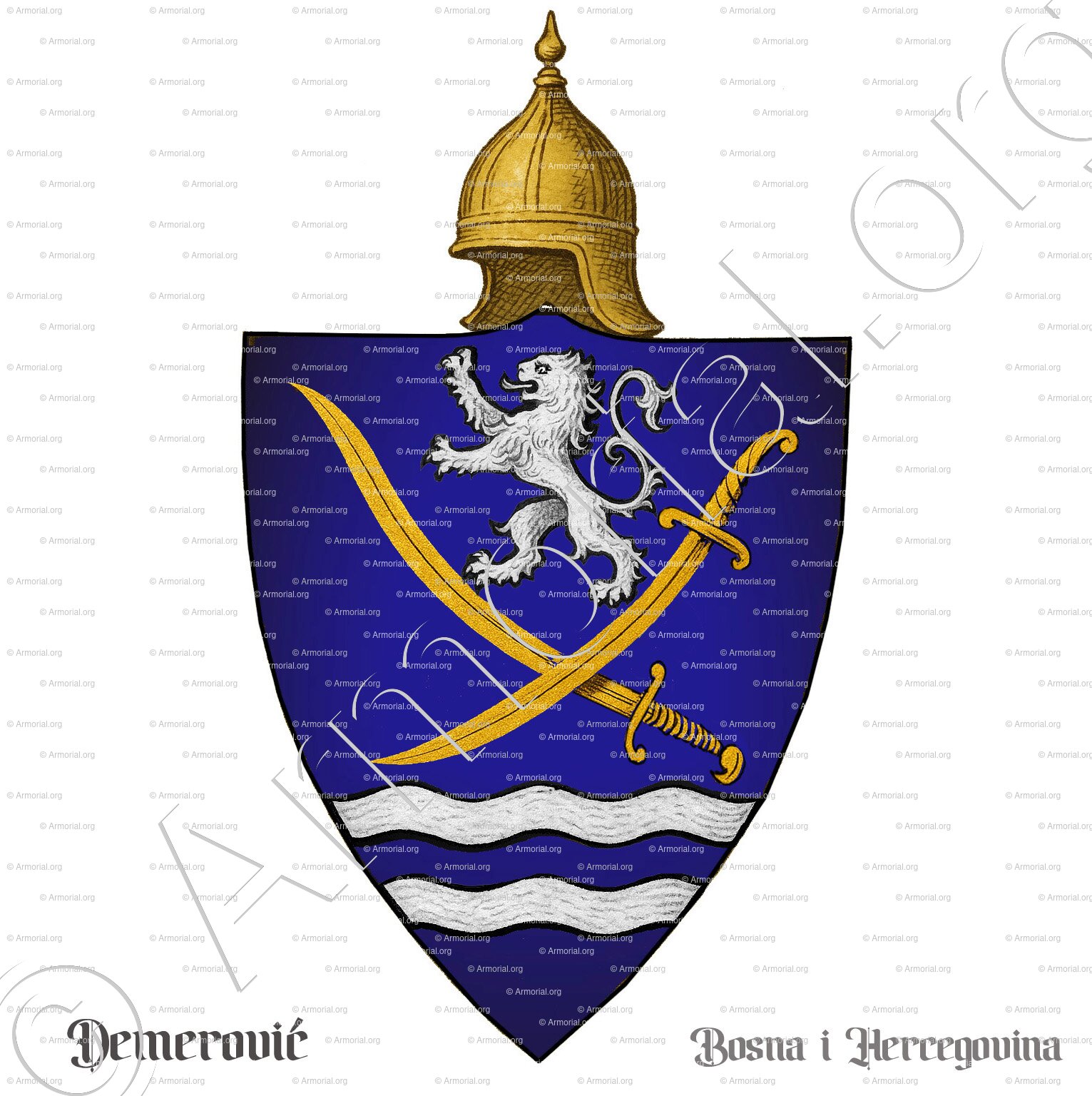
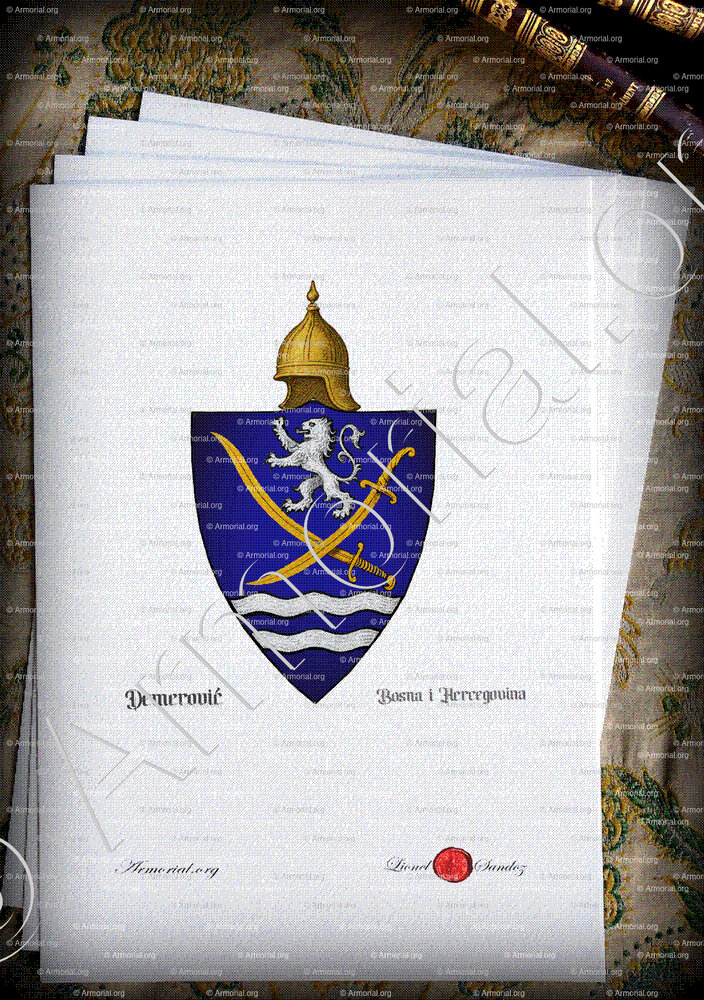
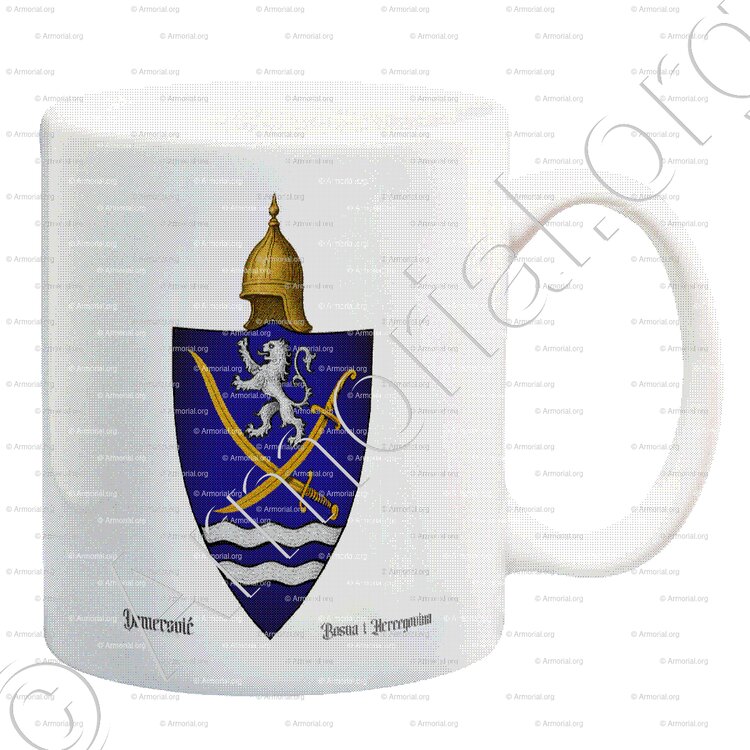
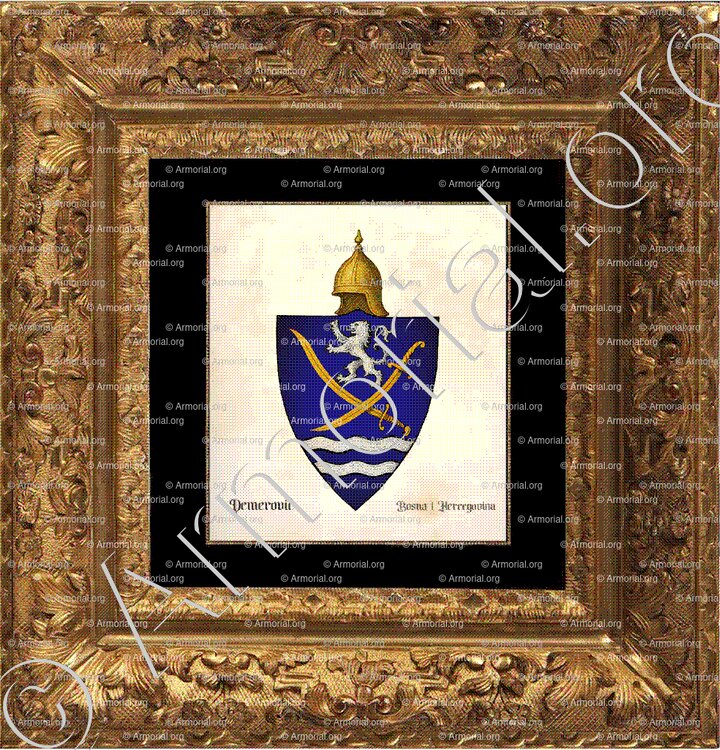
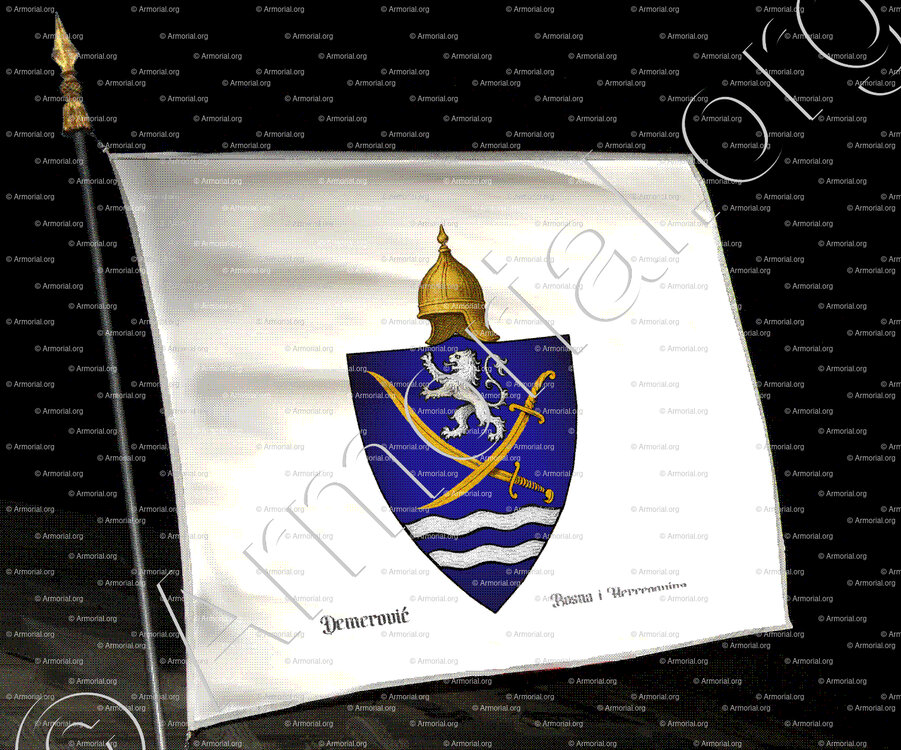
« D’azur, à un yatagan (ou cimeterre) d’or, posé en pal ; accompagné en chef d’un lion rampant d’argent, et en pointe de trois fasces ondées d’argent. »
- Cimier : L’écu est timbré d’un casque de guerrier ottoman d’or.
⚜️ Symbolique des armoiries
- Courage et tradition guerrière (yatagan, casque ottoman)
- Noblesse et dignité (lion rampant)
- Paix, fidélité, profondeur spirituelle (azur)
- Ancrage territorial (fasces ondées)
⚜️ Origine et étymologie du nom DEMEROVIĆ (ou DEMIROVIĆ)
Le nom de famille DEMEROVIĆ est d’origine slave méridionale, typiquement balkanique, et se concentre principalement en Bosnie-Herzégovine, Croatie, Serbie et Monténégro, avec une forte présence parmi les communautés bosniaques musulmanes.
Formé selon le modèle patronymique slave en -ović (« fils de » ou « descendant de »), il dérive directement du prénom ou surnom Demir, d’origine turque, signifiant littéralement « fer ».
Ainsi, DEMEROVIĆ signifie « fils de Demir » ou, par extension, « descendant de l’homme de fer » — une référence à la force, à la résistance et à la robustesse, qualités associées au métal dans les cultures turque et balkanique.
Ce nom émerge au Moyen Âge tardif, durant la domination ottomane en Bosnie (XVe–XIXe siècles), période où de nombreux patronymes turcs ou turquisés s’implantèrent parmi les élites administratives, artisanales et militaires islamisées.
Il reflète souvent une ascendance liée aux métiers du fer (forgerons, armuriers) ou symbolise une lignée marquée par la résilience dans un contexte historique de conflits, conversions et migrations.
Attesté dès le XVIe siècle dans les registres ottomans de Podrinje (vallée de la Drina, zone frontalière bosno-serbe), il s’est diffusé dans les régions sous influence turco-islamique.
En résumé : DEMEROVIĆ = héritier du fer, forgé dans l’histoire ottomane des Balkans.
⚜️ Détails sur les forgerons ottomans liés aux DEMEROVIĆ / DEMIROVIĆ (XVe–XVIIIe siècles)
Les forgerons portant le nom Demir (ou demirci en turc ottoman) formaient une corporation (esnaf) semi-autonome rattachée au corps des janissaires ou aux garnisons frontalières (kapi).
Lieu d’implantation : Foča, Goražde, Pljevlja (Sandžak) ; ateliers situés près des ponts (ex. : pont sur la Drina à Foča) pour faciliter le transport du minerai.
Selon le Defter-i demirciyan de Foča daté de 1598 et conservé aux Archives ottomanes de Sarajevo, les forgerons produisaient divers équipements militaires, notamment le yatagan, un sabre courbe destiné aux sipahis et doté d'une lame en acier damassé (çelik) gravée de versets coraniques ; la zirh gömlek, une cotte de mailles composée d'anneaux en fer étiré à froid ; le nal, un fer à cheval pour la cavalerie fabriqué à partir d'un alliage de fer et de charbon de bois local ; ainsi que le top güllesi, un boulet de canon en fonte obtenue au four à réverbère.
Les DEMEROVIĆ / DEMIROVIĆ de Foča détenaient le privilège exclusif de fournir les fers de lance pour la garnison de Herzégovine (firman de 1623).
⚜️ Variantes :
DEMEROVIĆ (variante croate ou serbe, de DEMIROVIĆ, transcription latine standard en Bosnie-Herzégovine)
DEMIROVIĆ (forme standard accentuée en bosniaque)
DEMIROV (forme serbe/croate simplifiée)
DEMIRAJ (adaptation albanaise)
DEMIROVIC-SMITH (diaspora occidentale)
DEMIROVITS (rare, transcription hongroise ou allemande)
DEMIROGLU (forme turque équivalente, « fils de Demir »)
⚜️ Symbolique du nom
DEMIR, signifiant « fer » en turc, symbolise la force brute, la solidité inébranlable et la fidélité éprouvée dans les cultures ottomane et balkanique.
Évoquant le forgeron maître du feu, il incarne le courage, la création par le travail et la protection guerrière.
En résumé : fer = résistance, feu = transformation, forge = héritage héroïque.
⚜️ Histoire et distribution géographique de la famille DEMEROVIĆ
La famille DEMEROVIĆ s’inscrit dans l’histoire tourmentée des Balkans, successivement marqués par les empires ottoman, austro-hongrois et yougoslave.
Ses porteurs, majoritairement bosniaques musulmans, mais aussi croates et monténégrins, ont été affectés par les grandes vagues de migrations internes provoquées par les conflits : guerres balkaniques (1912-1913), Seconde Guerre mondiale, et surtout guerre de Bosnie (1992-1995).
Au début du XXᵉ siècle, des DEMEROVIĆ sont encore attestés à Bjelina Gornja (Bjelina-Haute), dans la région de Podrinje.
⚜️ Contexte historique
✶ A. Origines (XVe–XVIe siècles)
Islamisation progressive des populations slaves méridionales sous l’Empire ottoman.
Les Demir sont souvent des forgerons militaires (turc demirci) attachés aux garnisons (kapi) de Foča, Goražde ou Pljevlja.
Le suffixe -ović se fixe au XVIIᵉ siècle lors des recensements ottomans (defter).
✶ B. Période austro-hongroise (1878–1918)
Les DEMIROVIĆ figurent parmi les familles musulmanes citadines de Sarajevo, Mostar et Travnik.
Nombreux négociants en métaux (fer, cuivre) sur la route Sarajevo–Dubrovnik.
✶ C. Yougoslavie titiste (1945–1992)
Maintien du nom malgré la politique de "fraternité et unité".
Migration vers les centres industriels (Zenica, Tuzla).
✶ D. Guerres de Yougoslavie (1992–1995)
Dispersion massive :
Réfugiés vers l’Allemagne, l’Autriche, la Suède.
Exil intérieur vers la Fédération de Bosnie-Herzégovine.
Création de diasporas structurées (associations DEMIROVIĆ à Berlin, Chicago, Melbourne).
✶ E. XXIe siècle
Aujourd’hui, le nom recense plusieurs milliers d’occurrences, concentrées en Europe du Sud-Est :
~70 % en Bosnie-Herzégovine et au Monténégro
Présence notable en Croatie et Serbie
Diaspora significative en Allemagne, Autriche, États-Unis et Australie depuis le XXᵉ siècle.
Historiquement :
En Podrinje, les DEMEROVIĆ étaient souvent agriculteurs, artisans ou commerçants.
Dans les régions de Kotor (Monténégro) ou Zagreb, ils s’intégraient à des communautés rurales ou urbaines.
Sous l’administration austro-hongroise, les DEMEROVIĆ bosniaques appartenaient fréquemment à la classe des effendis — bourgeoisie musulmane instruite, composée de juges religieux, imams, commerçants ou artisans prospères.
Ils formaient un maillon essentiel du tissu social entre Vlasenica, Kulen-Vakuf et Banja Luka, contribuant à la vie religieuse, économique et artisanale.
Bien que non rattachée à une noblesse titrée, la famille émergea comme une bourgeoisie montante sous l’Empire ottoman, où le prénom Demir était courant parmi les convertis à l’islam et dans les milieux marchands.
En résumé :
DEMEROVIĆ = lignée résiliente, ancrée dans l’islam bosniaque, entre forge, foi et commerce, au cœur des tempêtes balkaniques.
⚜️ Notes générales sur le "E" et le *I" des DEMEROVIĆ vs. DEMIROVIĆ
Les variantes d'orthographe (DEMEROVIĆ vs. DEMIROVIĆ) sont courantes dans les noms balkaniques en raison de transcriptions historiques (ottomane, austro-hongroise) et de conventions modernes (bosniaque/monténégrine avec I pour refléter la prononciation /demi/). Les figures historiques du XIXe siècle conservent souvent l'E, tandis que les contemporaines adoptent l'I.
D'autres mentions incluent des figures locales dans les arts, le sport ou le commerce, mais sans lignée nobiliaire documentée.
⚜️ Figures notables
Plusieurs membres de la famille se sont illustrés dans divers domaines :
✶ Husein DEMEROVIĆ (ou DEMIROVIĆ), mort en 1792, inhumé avec son marteau cérémonial en argent.
Husein DEMEROVIĆ (ou DEMEROVIĆ), maître forgeron renommé de Foča, exerça son art au XVIIIᵉ siècle dans les ateliers ottomans de Bosnie. Spécialisé dans la production d’armes et d’équipements militaires — yatagans damassés, cottes de mailles (zirh gömlek), fers à cheval (nal) et boulets de canon (top güllesi) —, il incarnait l’excellence technique des corporations enregistrées dans le Defter-i demirciyan de 1598, dont la tradition perdura.
Mort en 1792, fut inhumé à Foča, dans le cimetière ottoman adjacent à la mosquée Aladža (Alaca Camii), où les maîtres forgerons de la corporation des demirciyan étaient traditionnellement enterrés avec leurs insignes honorifiques. Sa tombe, ornée d’un marteau cérémonial en argent, se trouve parmi celles des artisans du XVIIIᵉ siècle, non loin des anciens ateliers de forge documentés dans le Defter-i demirciyan.
✶ Husein effendi DEMIROVIĆ (v. 1855 – après 1910)
Imam et muderris (professeur de medresa) à Vlasenica (Podrinje oriental) entre 1885 et 1905 environ. Issu d’une famille bosniaque musulmane établie dans la vallée de la Drina, il fut formé dans les medresas ottomanes de Sarajevo (probablement Gazi Husrev-beg) ou de Zvornik, avant l’annexion austro-hongroise de 1878.
Nommé imam de la mosquée Hajrija (ou d’une mosquée voisine) vers 1890, il enseigna le fiqh hanéfite, le tafsir et l’adab à une génération d’élèves qui deviendront effendis sous l’administration impériale. Sous le régime austro-hongrois, il fit partie des oulémas locaux chargés de maintenir l’enseignement religieux traditionnel tout en s’adaptant aux nouvelles exigences administratives (enregistrement des naissances, mariages, décès).
Figure discrète mais respectée, il incarna la continuité spirituelle de la communauté musulmane du Podrinje face aux réformes séculières de Vienne. Son nom apparaît dans les registres paroissiaux ottomans tardifs et dans les rapports consulaires austro-hongrois sur l’organisation religieuse en Bosnie orientale (archives de Sarajevo, fonds Zemaljski Muzej).
Aucune œuvre écrite ne lui est attribuée, mais son rôle éducatif a contribué à former plusieurs imams actifs jusqu’à la Première Guerre mondiale.
✶ DEMEROVIĆ Husein effendi & DEMIROVIĆ Mehmed (Meho)
Marchands musulmans de Kulen Vakuf (district de Bosanski Petrovac), actifs 1891–1893. Issus d’une famille bosniaque du Podrinje installée à Kulen Vakuf après 1878, Husein effendi Demirović (v. 1845 – après 1905) et son fils Mehmed « Meho » Demirović (v. 1870 – après 1910) formaient un duo commercial prospère dans le bazar frontalier de la ville, alors en pleine modernisation austro-hongroise.
✶ DEMEROVIĆ Osman & DEMEROVIĆ Derviš
Tanneurs (kožarnice) de la famille bosniaque, probablement installés à Banja Luka ou Travnik au XIXe siècle. Issus de la bourgeoisie artisanale musulmane sous l’Empire ottoman, ils excellaient dans le travail du cuir, un métier essentiel aux marchés locaux (cuirs, chaussures, harnais). Leur activité, typique des guildes (esnafs) de Podrinje, incarnait la résilience économique et le savoir-faire hérité des forgerons ancestraux dans une région en transition vers l’administration austro-hongroise.
✶ Andrea DEMIROVIĆ (née en 1985)
Chanteuse et animatrice monténégrine, née le 17 juin 1985 à Podgorica, Andrea DEMIROVIĆ s’est imposée comme une figure emblématique de la scène balkanique. Formée à l’Académie de musique de Cetinje en pédagogie musicale, elle lance sa carrière en 2006 avec l’album Pjevajmo pjesme majke moje.
Sélectionnée le 23 janvier 2009 par RTCG, elle représente le Monténégro à l’Eurovision 2009 à Moscou avec « Just Get Out of My Life » (en anglais, une première), se classant 11e en demi-finale avec 44 points. Ce titre, écrit par Ralph Siegel et Bernd Meinunger, marque un tournant international.
Parallèlement, elle brille comme animatrice à la télévision nationale monténégrine, et poursuit sa carrière musicale avec des hits comme « Odlazim » (2012) et une participation au Baltic Song Contest 2013. Professeure de musique, elle incarne la vitalité culturelle monténégrine, liant tradition et modernité.
✶ Ermedin DEMIROVIĆ (né en 1998) : Ermedin Demirović, né le 25 mars 1998 à Hambourg (Allemagne) de parents bosniaques, est un footballeur professionnel international bosniaque évoluant comme attaquant au VfB Stuttgart en Bundesliga depuis juillet 2024. Il incarne la diaspora bosniaque réussie, avec plus de 30 sélections en équipe nationale depuis 2021.
✶ Husein DEMIROVIĆ (1882-1942) : Écrivain et poète bosniaque (musulman), figure notable de la renaissance culturelle bosniaque au début du XXe siècle, sous l'occupation austro-hongroise (1908-1918). Ses œuvres explorent l'identité bosniaque rurale, les traditions et les thèmes folkloriques, contribuant à la littérature nationale émergente.
✶ Alex DEMIROVIĆ : Alex Demirović (né en 1952) est un sociologue allemand d'origine bosniaque, affilié à la Fondation Rosa Luxemburg et à l'Institut de recherche sociale de Francfort. Il est un expert reconnu de la théorie critique (héritage de l'École de Francfort), de la sociologie politique, de l'État et des intellectuels non conformistes. Ses travaux portent en particulier sur la philosophie politique marxiste et l'analyse de l'État moderne.
⚜️ Bibliographie
- Neuigkeits-Welt, ...1886
- Zbornik za narodni život i običaje južnih Slavena, 1898.
- Bosnischer Bote: Universal-Hand- u. Adressbuch Bosnien-Hercegovina, 1899.
- Život i običaji plemena Kuča (traduisible par Vie et coutumes de la tribu des Kuči), par Ivo Šajnović Kola, 1901.
⚜️ Auteur : Lionel Sandoz, héraldiste – Armorial.org, 2025.
⚔️⚔️⚔️⚔️⚔️⚔️⚔️⚔️⚔️⚔️⚔️⚔️⚔️⚔️⚔️⚔️⚔️⚔️⚔️⚔️⚔️⚔️⚔️⚔️
⚜️ DEMEROVIĆ vs. DEMIROVIĆ
ДЕМЕРОВИЋ (Демеровић) vs. ДЕМИРОВИЋ (Демировић) (Serbian/Bosnian Cyrillic)
Bosnia-Herzegovina, Croatia, Serbia.
Ottoman and Austro-Hungarian Empires.
Typical Slavo-Muslim surname of Bosniak populations, Serbian Muslims, or Islamized Montenegrins.
Originating from Kulen Vakuf, Bijeljina, Kola (near Banja Luka), and Vlasenica.
A land referred to as “zemlja eno Demerović” is mentioned in the ethnographic work of Ivo Šajnović on Kola (Život i običaji plemena Kuča, 1901).
Family that entered Balkan nobility under the Ottoman Empire (15th–19th centuries).
⚜️ Coat of Arms
“Azure, a yatagan (or scimitar) or, placed palewise; accompanied in chief by a lion rampant argent, and in base by three bars wavy argent.”
- Crest: The shield is timbred with an Ottoman warrior’s helmet or.
⚜️ Symbolism of the Coat of Arms
Courage and warrior tradition (yatagan, Ottoman helmet)
Nobility and dignity (lion rampant)
Peace, loyalty, spiritual depth (azure)
Territorial anchoring (bars wavy)
⚜️ Origin and Etymology of the Surname DEMEROVIĆ (or DEMIROVIĆ)
The surname DEMEROVIĆ is of South Slavic origin, typically Balkan, and is concentrated mainly in Bosnia-Herzegovina, Croatia, Serbia, and Montenegro, with a strong presence among Bosniak Muslim communities.
Formed according to the Slavic patronymic model in -ović (“son of” or “descendant of”), it derives directly from the first name or nickname Demir, of Turkish origin, literally meaning “iron.”
Thus, DEMEROVIĆ means “son of Demir” or, by extension, “descendant of the man of iron”—a reference to strength, resistance, and robustness, qualities associated with the metal in Turkish and Balkan cultures.
This name emerged in the late Middle Ages, during Ottoman domination in Bosnia (15th–19th centuries), a period when many Turkish or Turkicized patronymics became established among Islamized administrative, artisanal, and military elites.
It often reflects ancestry linked to iron trades (blacksmiths, armorers) or symbolizes a lineage marked by resilience in a historical context of conflicts, conversions, and migrations.
Attested as early as the 16th century in Ottoman registers of Podrinje (Drina Valley, Bosnian-Serbian border area), it spread to regions under Turco-Islamic influence.
In summary: DEMEROVIĆ = heir of iron, forged in the Ottoman history of the Balkans.
⚜️ Details on Ottoman Blacksmiths Linked to the DEMEROVIĆ / DEMIROVIĆ (15th–18th Centuries)
Blacksmiths bearing the name Demir (or demirci in Ottoman Turkish) formed a semi-autonomous guild (esnaf) attached to the Janissary corps or border garrisons (kapi).
Places of establishment: Foča, Goražde, Pljevlja (Sandžak); workshops located near bridges (e.g., the bridge over the Drina in Foča) to facilitate ore transport.
According to the Defter-i demirciyan of Foča dated 1598 and preserved in the Ottoman Archives of Sarajevo, the blacksmiths produced various military equipment, including the yatagan, a curved saber intended for sipahis and featuring a damascus steel blade (çelik) engraved with Quranic verses; the zirh gömlek, a chain mail shirt composed of cold-drawn iron rings; the nal, a horseshoe for cavalry made from an alloy of iron and local charcoal; as well as the top güllesi, a cannonball cast in a reverberatory furnace.
The DEMEROVIĆ / DEMIROVIĆ of Foča held the exclusive privilege of supplying spearheads for the Herzegovina garrison (firman of 1623).
⚜️ Variants:
DEMEROVIĆ (Croatian or Serbian variant, from DEMIROVIĆ, standard Latin transcription in Bosnia-Herzegovina)
DEMIROVIĆ (standard accented form in Bosnian)
DEMIROV (simplified Serbian/Croatian form)
DEMIRAJ (Albanian adaptation)
DEMIROVIC-SMITH (Western diaspora)
DEMIROVITS (rare, Hungarian or German transcription)
DEMIROGLU (Turkish equivalent form, “son of Demir”)
⚜️ Symbolism of the Name
DEMIR, meaning “iron” in Turkish, symbolizes brute strength, unshakable solidity and proven fidelity in Ottoman and Balkan cultures.
Evoking the blacksmith master of fire, it embodies courage, creation through work and warrior protection.
In summary: iron = resistance, fire = transformation, forge = heroic heritage.
⚜️ History and Geographical Distribution of the DEMEROVIĆ Family
The DEMEROVIĆ family is part of the tumultuous history of the Balkans, successively marked by the Ottoman, Austro-Hungarian and Yugoslav empires.
Its bearers, mostly Bosniak Muslims, but also Croats and Montenegrins, were affected by major waves of internal migrations caused by conflicts: Balkan wars (1912-1913), Second World War, and especially the Bosnian War (1992-1995).
At the beginning of the 20th century, DEMEROVIĆ are still attested in Bjelina Gornja (Upper Bjelina), in the Podrinje region.
⚜️ Historical Context
✶ A. Origins (15th–16th Centuries)
Gradual Islamization of South Slavic populations under the Ottoman Empire.
The Demir are often military blacksmiths (Turkish demirci) attached to garrisons (kapi) in Foča, Goražde or Pljevlja.
The suffix -ović became fixed in the 17th century during Ottoman censuses (defter).
✶ B. Austro-Hungarian Period (1878–1918)
The DEMIROVIĆ appear among urban Muslim families in Sarajevo, Mostar and Travnik.
Numerous metal traders (iron, copper) on the Sarajevo–Dubrovnik route.
✶ C. Tito’s Yugoslavia (1945–1992)
Retention of the name despite the policy of “brotherhood and unity”.
Migration to industrial centers (Zenica, Tuzla).
✶ D. Yugoslav Wars (1992–1995)
Massive dispersion:
Refugees to Germany, Austria, Sweden.
Internal exile to the Federation of Bosnia-Herzegovina.
Creation of structured diasporas (DEMIROVIĆ associations in Berlin, Chicago, Melbourne).
✶ E. 21st Century
Today, the name records several thousand occurrences, concentrated in Southeast Europe:
~70% in Bosnia-Herzegovina and Montenegro
Notable presence in Croatia and Serbia
Significant diaspora in Germany, Austria, United States and Australia since the 20th century.
Historically:
In Podrinje, the DEMEROVIĆ were often farmers, artisans or merchants.
In the regions of Kotor (Montenegro) or Zagreb, they integrated into rural or urban communities.
Under Austro-Hungarian administration, Bosniak DEMEROVIĆ frequently belonged to the class of effendis — educated Muslim bourgeoisie, composed of religious judges, imams, merchants or prosperous artisans.
They formed an essential link in the social fabric between Vlasenica, Kulen-Vakuf and Banja Luka, contributing to religious, economic and artisanal life.
Although not attached to a titled nobility, the family emerged as a rising bourgeoisie under the Ottoman Empire, where the first name Demir was common among converts to Islam and in merchant circles.
In summary:
DEMEROVIĆ = resilient lineage, rooted in Bosniak Islam, between forge, faith and commerce, at the heart of Balkan storms.
⚜️ General Notes on the “E” and “I” in DEMEROVIĆ vs. DEMIROVIĆ
Spelling variants (DEMEROVIĆ vs. DEMIROVIĆ) are common in Balkan names due to historical transcriptions (Ottoman, Austro-Hungarian) and modern conventions (Bosnian/Montenegrin with I to reflect the pronunciation /demi/). Historical figures from the 19th century often retain the E, while contemporaries adopt the I.
Other mentions include local figures in the arts, sports or commerce, but without documented noble lineage.
⚜️ Notable Figures
Several family members have distinguished themselves in various fields:
✶ Husein DEMEROVIĆ (or DEMIROVIĆ), died in 1792, buried with his ceremonial silver hammer.
Husein DEMEROVIĆ (or DEMEROVIĆ), renowned master blacksmith of Foča, practiced his art in the 18th century in the Ottoman workshops of Bosnia. Specialized in the production of weapons and military equipment — damascus yatagans, chain mail shirts (zirh gömlek), horseshoes (nal) and cannonballs (top güllesi) —, he embodied the technical excellence of the corporations recorded in the Defter-i demirciyan of 1598, whose tradition endured.
Died in 1792, was buried in Foča, in the Ottoman cemetery adjacent to the Aladža Mosque (Alaca Camii), where master blacksmiths of the demirciyan corporation were traditionally buried with their honorary insignia. His tomb, adorned with a ceremonial silver hammer, is among those of 18th-century artisans, not far from the former forge workshops documented in the Defter-i demirciyan.
✶ Husein effendi DEMIROVIĆ (c. 1855 – after 1910)
Imam and muderris (medresa teacher) in Vlasenica (eastern Podrinje) between approximately 1885 and 1905. From a Bosniak Muslim family established in the Drina valley, he was trained in the Ottoman medresas of Sarajevo (probably Gazi Husrev-beg) or Zvornik, before the Austro-Hungarian annexation of 1878.
Appointed imam of the Hajrija Mosque (or a neighboring mosque) around 1890, he taught Hanafi fiqh, tafsir and adab to a generation of students who would become effendis under the imperial administration. Under the Austro-Hungarian regime, he was part of the local ulema responsible for maintaining traditional religious education while adapting to new administrative requirements (registration of births, marriages, deaths).
A discreet but respected figure, he embodied the spiritual continuity of the Muslim community of Podrinje in the face of Vienna’s secular reforms. His name appears in late Ottoman parish registers and in Austro-Hungarian consular reports on religious organization in eastern Bosnia (Sarajevo archives, Zemaljski Muzej funds).
No written work is attributed to him, but his educational role helped train several imams active until the First World War.
✶ DEMEROVIĆ Husein effendi & DEMIROVIĆ Mehmed (Meho)
Muslim merchants of Kulen Vakuf (Bosanski Petrovac district), active 1891–1893. From a Bosniak family from Podrinje settled in Kulen Vakuf after 1878, Husein effendi Demirović (c. 1845 – after 1905) and his son Mehmed “Meho” Demirović (c. 1870 – after 1910) formed a prosperous commercial duo in the border town’s bazaar, then undergoing Austro-Hungarian modernization.
✶ DEMEROVIĆ Osman & DEMEROVIĆ Derviš
Tanners (kožarnice) of the Bosniak family, probably established in Banja Luka or Travnik in the 19th century. From the Muslim artisanal bourgeoisie under the Ottoman Empire, they excelled in leather work, an essential trade in local markets (leathers, shoes, harnesses). Their activity, typical of the guilds (esnafs) of Podrinje, embodied economic resilience and inherited know-how from ancestral blacksmiths in a region transitioning to Austro-Hungarian administration.
✶ Andrea DEMIROVIĆ (born in 1985)
Montenegrin singer and presenter, born on June 17, 1985 in Podgorica, Andrea DEMIROVIĆ has established herself as an emblematic figure of the Balkan scene. Trained at the Cetinje Music Academy in musical pedagogy, she launched her career in 2006 with the album Pjevajmo pjesme majke moje.
Selected on January 23, 2009 by RTCG, she represented Montenegro at Eurovision 2009 in Moscow with “Just Get Out of My Life” (in English, a first), ranking 11th in the semi-final with 44 points. This title, written by Ralph Siegel and Bernd Meinunger, marked an international turning point.
In parallel, she shines as a presenter on Montenegrin national television, and continues her musical career with hits like “Odlazim” (2012) and a participation in the Baltic Song Contest 2013. Music teacher, she embodies Montenegrin cultural vitality, linking tradition and modernity.
✶ Ermedin DEMIROVIĆ (born in 1998): Ermedin Demirović, born on March 25, 1998 in Hamburg (Germany) to Bosniak parents, is a professional Bosnian international footballer playing as a striker for VfB Stuttgart in the Bundesliga since July 2024. He embodies the successful Bosniak diaspora, with more than 30 caps for the national team since 2021.
✶ Husein DEMIROVIĆ (1882-1942): Bosniak (Muslim) writer and poet, notable figure of the Bosniak cultural renaissance at the beginning of the 20th century, under Austro-Hungarian occupation (1908-1918). His works explore rural Bosniak identity, traditions and folkloric themes, contributing to the emerging national literature.
✶ Alex DEMIROVIĆ: Alex Demirović (born in 1952) is a German sociologist of Bosniak origin, affiliated with the Rosa Luxemburg Foundation and the Frankfurt Institute for Social Research. He is a recognized expert in critical theory (legacy of the Frankfurt School), political sociology, the State and non-conformist intellectuals. His works focus in particular on Marxist political philosophy and the analysis of the modern State.
⚜️ Bibliography
Neuigkeits-Welt, ...1886
Zbornik za narodni život i običaji južnih Slavena, 1898.
Bosnischer Bote: Universal-Hand- u. Adressbuch Bosnien-Hercegovina, 1899.
Život i običaji plemena Kuča (translatable as Life and Customs of the Kuči Tribe), by Ivo Šajnović Kola, 1901.
⚜️ Author: Lionel Sandoz, heraldist – Armorial.org, 2025.
⚔️⚔️⚔️⚔️⚔️⚔️⚔️⚔️⚔️⚔️⚔️⚔️⚔️⚔️⚔️⚔️⚔️⚔️⚔️⚔️⚔️⚔️⚔️⚔️
PARTAGEZ SUR LES RÉSEAUX SOCIAUX
LES AVIS
Il n'y a aucune note pour le moment. Soyez le premier à évaluer !
DONNEZ UNE NOTE