


DESCRIPTION
⚜️ FRESNEAU
Poitou
France
FRESNEAU, Lord of La GATAUDIÈRE
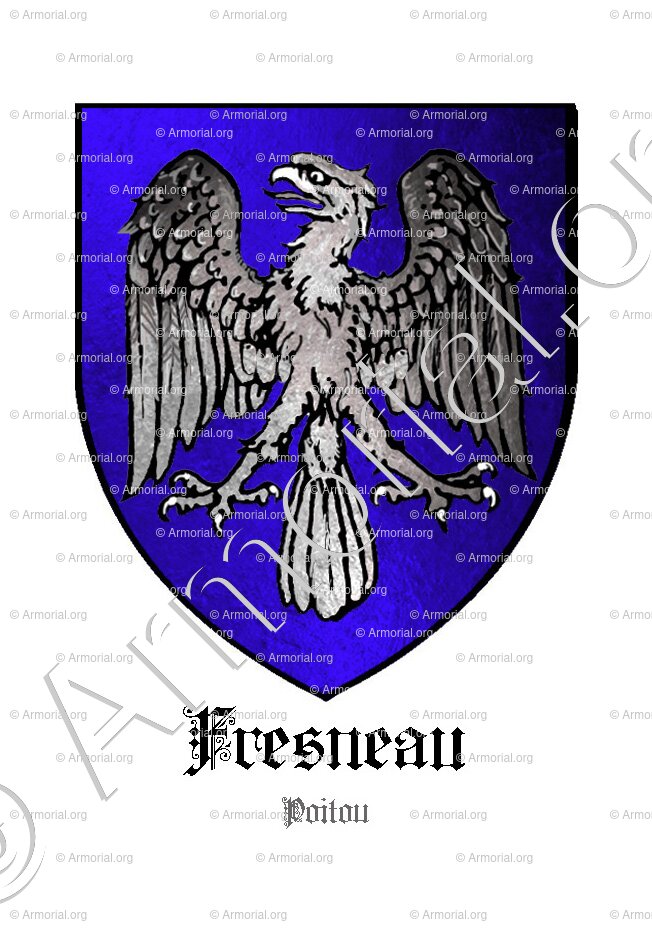
⚜️ Arms:
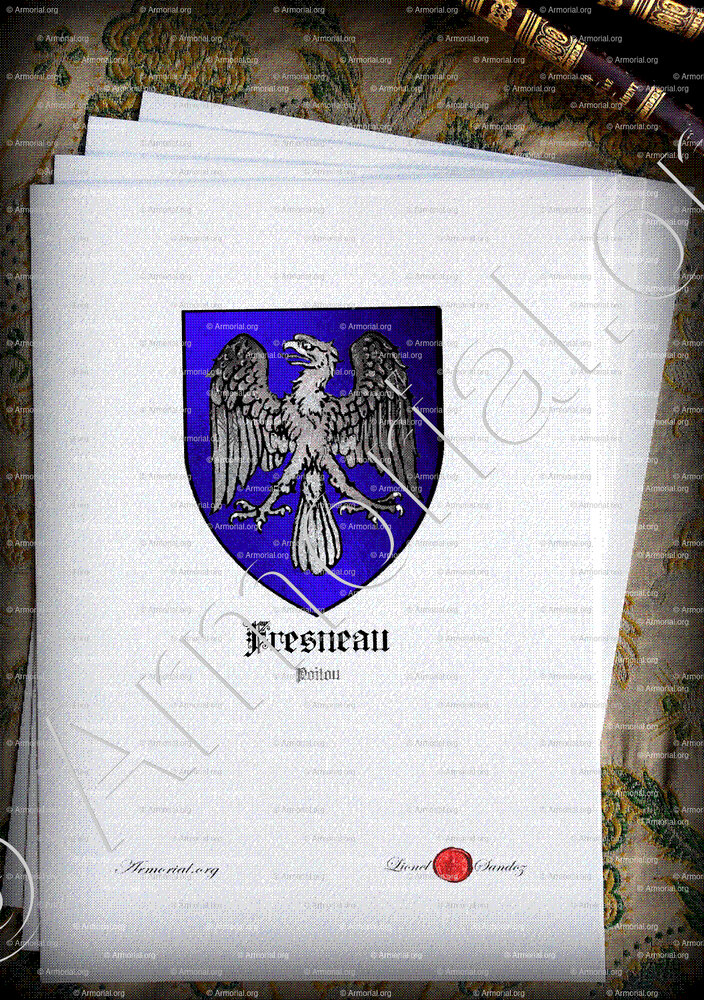
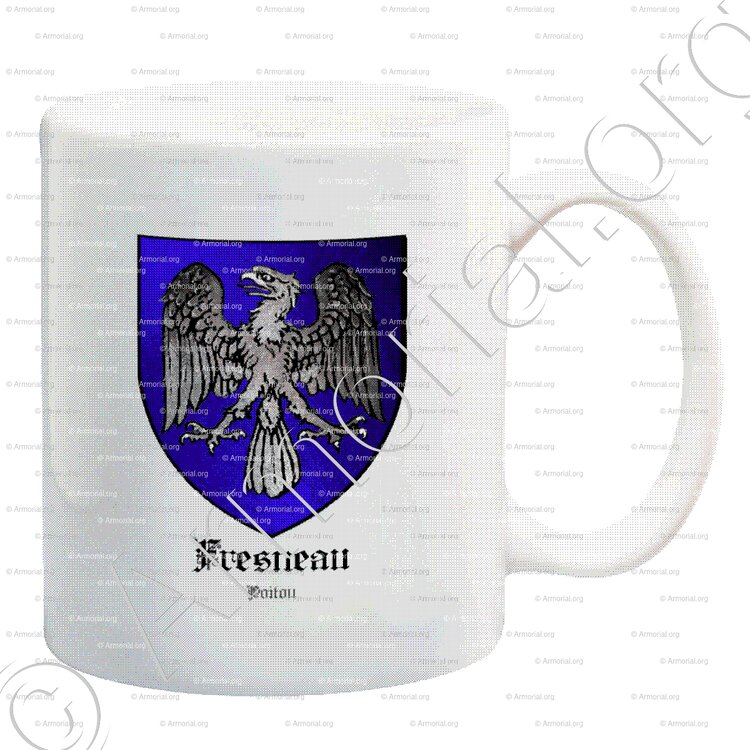
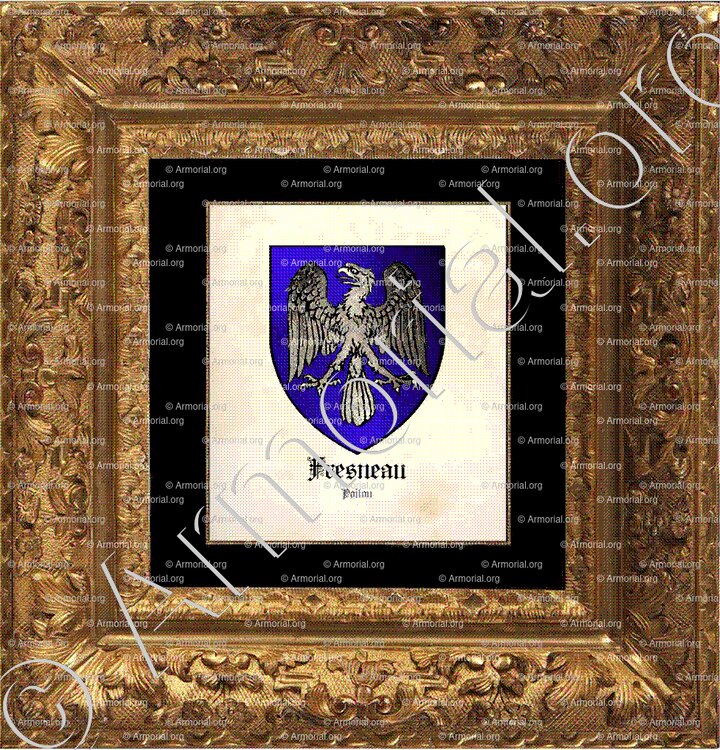
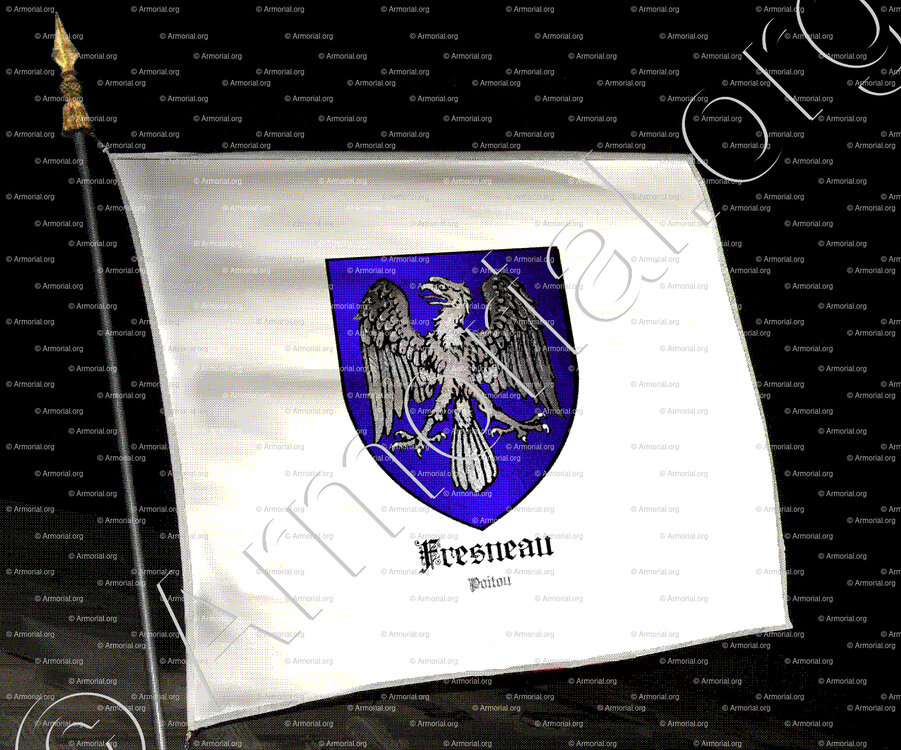
"Azure, an eagle Argent, wings lowered."
⚜️ Sources:
- Familles nobles en Europe, by Victor Rolland and Henri Rolland, 1904–1926.
- Armorial poitevin by Pierre Petiet: alphabetical list of noble or old bourgeois families living or having lived in Poitou, followed by an index of arms classified by heraldic figures, 1911.
⚜️ ORIGIN
The name FRESNEAU evokes a place planted with ash trees (frênes), a common toponymic formation in Poitou-Charentes (variants: Fresnaud, Fresnault).
The earliest mentions are concentrated in the 16ᵗʰ century in notarial acts from Poitiers and Niort.
Connected to fiefs such as CHÂTELET-FRESNEAU or Nuaillé (Saintonge, from 1370).
Following regional etymological patterns (consistent with Albert Dauzat), it designates a wooded estate or a small river bordered by ash trees.
⚜️ The FRESNEAU family from Poitou
The de FRESNEAU (or du FRESNEAU) family, a noble house of Poitou origin, appears in the archives as early as the late Middle Ages as a line of minor landed nobility rooted in the historic regions of Poitou, Saintonge and Vendée (today’s Vienne, Deux-Sèvres, Charente-Maritime and Vendée).
The surname, derived from Latin fraxinus (ash tree), refers to a wooded toponym or an ash grove, typical of Picto-Charentais formations with the suffix -eau. Attested since the 16ᵗʰ century around Niort, Poitiers, Guitinières and Châtellerault, it spread through alliances and migrations toward Touraine, Anjou, Brittany and even the colonies (French Guiana).
The FRESNEAU distinguished themselves through rural seigneuries (Marigny, La MOTHE-FRESNEAU, Nuaillé, La GATAUDIÈRE), ecclesiastical, notarial and administrative offices, as well as scientific and military contributions in the 18ᵗʰ century.
Their history reflects the rise of a nobility of extraction or of the robe, marked by feudal homage, ruin following the Wars of Religion, and dispersion after the Revolution.
This notice integrates Poitevin archives (Saint-Benoît, Poitiers notarial registers), armorials and recent genealogies.
⚜️ LA MOTHE-FRESNEAU (14ᵗʰ–18ᵗʰ centuries)
Fortified motte from the 14ᵗʰ century, acquired by the FRESNEAU in the 16ᵗʰ century by alliance, inheritance or purchase (fiefs of La MOTHE-FRESNEAU and Nuaillé in Saintonge, mentioned since 1370).
Linked to the Lords of Lusignan (12ᵗʰ–13ᵗʰ centuries), later passing to the royal domain (14ᵗʰ c.).
First mention of the castle in 1408 (homage of Symon Mourault to the Duke of Berry).
Ruined after the Wars of Religion (late 16ᵗʰ century).
Around 1670, René du CHÂTELET-FRESNEAU (born c. 1640-1650, a Lorrain-Poitevin nobleman) inherited or purchased it.
Notarial acts from Poitiers (1685) record land repurchases for 4,000 livres and repairs to the estate (1683-1687). Styled “noble and powerful lord,” with rights of high and low justice.
Sold around 1690-1700 to the Nuchèze family due to debt; the branch became extinct in the 18ᵗʰ century.
⚜️ FRESNEAU, Lord of La GATAUDIÈRE
The lordship of La GATAUDIÈRE (or GATEAUDIÈRE, in Charente-Maritime, near Marennes in Saintonge) is a noble estate attested since the Middle Ages, under the fortress of Broue (14ᵗʰ c.), with military duties, a windmill, warrens, and a feudal manor.
In the 17ᵗʰ century, it passed to the FRESNEAU through marriage: François FRESNEAU de La RUCHAUDERIE (esquire, Secretary to the King at the Cour des aides of Guyenne, † c. 1720) married Anne Regnauld in 1700, who brought the fief as her dowry.
He adopted the title Lord of La GATAUDIÈRE, where their son, the renowned François FRESNEAU de La GATAUDIÈRE (1703-1770), was born.
This latter, mathematician and engineer to the King (officer of the Corps of Engineers), inherited the domain in 1751 from his mother and rebuilt it as a château in 1749, blending Louis XIV, Regency and Louis XV styles. Returning from French Guiana in 1748—where he had fortified Cayenne and discovered Hevea latex in 1747, laying the foundations of synthetic rubber with a memoir of 1763—he carried out pioneering botanical experiments there, introducing the potato into France in the 1750s, long before Parmentier.
Married in 1738 to Cécile Solin-Baron, he had eight children, only one of whom survived:
– Charles Jean-Baptiste FRESNEAU, whose daughter Anne-Julie (1775-1848) married in 1794 General François de CHASSELOUP-LAUBAT (1754-1833), commander of Napoleon’s engineers.
Thus, La GATAUDIÈRE passed to the CHASSELOUP-LAUBAT, then to the MURAT family (descendants of Joachim Murat), and remains today the property of Prince Achille MURAT de CHASSELOUP-LAUBAT.
This fief illustrates the noblesse de robe of Saintonge, uniting royal service, science, and military heritage.
Sources: Archives départementales de Charente-Maritime (estate and notarial records); François Fresneau, seigneur de La Gataudière, père du caoutchouc (F. de Chasseloup-Laubat, 1942).
⚜️ NOTABLE FIGURES
✶ Henri FRESNEAU (c. 1865-1870 – after 1899), tax collector, resident of Guémené-Penfao (Loire-Atlantique). Father of Pauline FRESNEAU (b. 14 Feb 1899, civil record). Civil servant of common birth, unrelated to the Poitevin nobility. (AD44, civil register of Guémené-Penfao, 1899.)
⚜️ BRIEF CHRONOLOGICAL HISTORY OF NOTABLE FIGURES
Organized chronologically, the genealogy reveals several interconnected branches, often identified by their lordships.
Allied families include Sassené, Bigot, Maridor, Girard de Charnacé, Beffroy and Regnauld.
⚜️ Late Middle Ages and 15ᵗʰ Century
– Jean de FRESNEAU, knight, lord of Crevant; married c. 1415 Rose de Maillé. His daughter Jeanne married c. 1430 Jacques Daillon, esquire, lord of La Chartreboûcherie.
– Hardouin de FRESNEAU, esquire, representative of the Duke of Anjou; received homage of Jean de Saligné (1433).
– Louis de FRESNEAU, abbot of Charroux (1479).
– N. de FRESNEAU, notary of L’Isle-Jourdain (1447).
– Jeanne de FRESNEAU, cited 1489 in a letter from Regnauld Chenu (Vendée).
– Jacques de FRESNEAU, lord of La Fresnaye; his daughter Rose married c. 1500 Louis Guyeneuf, esquire, lord of Bouliers.
– Marquise de FRESNEAU of Lussé married c. 1500 Sylvestre du Chaffault, esquire, lord of La Senardière.
– Jean de FRESNEAU (c. 1525-1530 – after 1570), merchant at Saint-Germain-des-Prés (Paris).
– Pierre de FRESNEAU, prior of La Madeleine de Parthenay (1533).
– Léonard de FRESNEAU, sworn clerk and notary of Châtellerault (1519).
– Madeleine de FRESNEAU, nun at Beaumont-lès-Tours (1566).
– Guillaume de FRESNEAU, esquire, lord of Marigny (Poitou), married Renée de Sassené (c. 1580).
⚜️ 16ᵗʰ Century
– Bertrand de FRESNEAU, homage for the Bouchet estate (1508).
– Françoise de FRESNEAU, widow of Antoine des Aubus (1517).
– Guillaume de FRESNEAU, esquire, lord of Marigny and Fresneau (village), † before 1585.
⚜️ 17ᵗʰ Century
– Jacques de FRESNEAU, received as Knight of Malta (30 May 1612).
– Nicolas de FRESNEAU (c. 1620-1630 – after 1680), esquire, lord of Beaurepaire and Cierges (Anjou).
– Antoine du FRESNEAU, esquire, lord of La Chaume (c. 1639).
– Charles du FRESNEAU, esquire, lord of Marigny (acts 1656 and 1660).
– Antoine du FRESNEAU, esquire, lord of Châtillon (moved 1680, registered arms 1698 at Richelieu).
– Jacques de FRESNEAU, prior of Savigny-sur-Vienne (1623).
– François de FRESNEAU, notary of Tiffauges (1677).
– René du CHÂTELET-FRESNEAU (c. 1640-1650 – c. 1690-1700), noble Poitevin of Lorrain-Poitevin origin, esquire and lord of La MOTHE-FRESNEAU.
⚜️ 18ᵗʰ–19ᵗʰ Centuries
– François FRESNEAU de La GATAUDIÈRE (1703-1770): engineer to Louis XV, discoverer of rubber and introducer of the potato in France (1750s).
– Armand FRESNEAU (1823-1900): owner of Kermadio (Brittany), mayor and deputy (1848-1876), senator (1879), created Roman count by Leo XIII (1891).
– Branches in Touraine, Anjou, and commoner lines (19ᵗʰ cent.).
⚜️ 20ᵗʰ Century
The FRESNEAU family from Poitou-Saintonge divided into noble and bourgeois branches after the Revolution.
– Noble branch – La GATAUDIÈRE (Charente-Maritime): legacy of François FRESNEAU (1703-1770), property transmitted to CHASSELOUP-LAUBAT → MURAT (currently Prince Achille MURAT de CHASSELOUP-LAUBAT).
– Noble branch – Kermadio (Morbihan): Armand FRESNEAU (1861-1936), Roman Count (Leo XIII, 1891).
– Bourgeois/regional branches: Sarthe (viticulture since 1925, AOC Jasnières), Vendée/Brittany (administrators and tax officials).
Total ≈ 1,275 births (1941-1990), mainly Deux-Sèvres and Sarthe.
→ Gradual shift from rural nobility to scientific and political bourgeoisie.
⚜️ HERALDRY
Main arms (Poitou, registered in Armorial général de Poitou/Nantes, Armorial poitevin Petiet 1911; Rolland 1904-1926):
"Azure, an eagle Argent, wings lowered."
Sources: Familles nobles en Europe; Armorial poitevin.
Variants:
– "Argent, a frêne (ash tree) eradicated Vert, between two stars Azure." (La GATAUDIÈRE branch; canting arms.)
– "Argent, a chevron Gules between three trefoils Vert." (Marigny/Châtellerault branch; Armorial of Touraine 1698, Malta registers.)
– "Quarterly complex (1698): Or and Argent with a cross Gules overall on a chevron, cantoned by rising eagles Sable; a bend fillet through the field."
⚜️ SYMBOLISM
– Azure = Loyalty.
– Eagle Argent, wings lowered = Vigilance, noble strength, possible Germanic or royal influences.
– Ash tree / stars = Elevation, divine protection. Seals Clairambault (17ᵗʰ c.); Armorial of Brittany (Potier de Courcy, 1890).
⚜️ Main Sources:
Armorial du Poitou, Beauchet & Filleau, 1891.
Armorial poitevin, René Pétiet, 1911.
Departmental Archives of Vienne and Charente-Maritime.
Armorials Petiet / Rolland.
⚜️ Author: Lionel Sandoz, Heraldist – Armorial.org, 2025.
PARTAGEZ SUR LES RÉSEAUX SOCIAUX
LES AVIS
Il n'y a aucune note pour le moment. Soyez le premier à évaluer !
DONNEZ UNE NOTE